
Neocochylis dubitana
(Hübner, 1799)
Little Conch
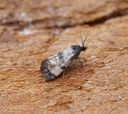
Neocochylis dubitana, commonly known as the Little Conch, is a small tortricid native to the Palearctic region with introduced in North America. The was originally described by Hübner in 1799 as Tortrix dubitana and has undergone several taxonomic revisions, most recently transferred from Cochylis to Neocochylis. It is a relatively well-documented species with over 800 observations on iNaturalist, reflecting both its actual abundance and the ease of identification among conch moths. The moth is associated with open where its larval plants occur.
Pronunciation
How to pronounce Neocochylis dubitana: //ˌniːoʊˈkɒkɪlɪs ˌdjuːbɪˈtɑːnə//
These audio files are automatically generated. While they are not always 100% accurate, they are a good starting point.
Identification
The Little Conch can be distinguished from similar Cochylini by its relatively plain forewing pattern lacking the strong contrasting bands seen in many . It most closely resembles Neocochylis hybridella, but has paler ground color and less pronounced dark markings. The male genitalia (examination required for certainty) show characteristic valvae with a distinct sacculus process. In North America, it may be confused with native Cochylini such as Cochylis hospes, which has more strongly banded forewings. The combination of small size, pale coloration, and the specific pattern of costal strigulae is diagnostic for field identification in most of its range.
Images
Appearance
are small with a wingspan of approximately 11–15 mm. The forewings are cream to pale ochre with distinct darker brown or reddish-brown markings, including a characteristic pattern of costal strigulae (fine streaks) and a well-defined fascia. The wing shape is somewhat rectangular with a slightly hooked apex, typical of the Cochylini tribe. Hindwings are pale grey-brown with darker fringes. At rest, the wings are held in a steep roof-like posture, concealing the . The bears a short, projecting tuft of .
Habitat
Open including grasslands, meadows, dunes, and coastal areas. Associated with disturbed ground and waste places where larval plants ( of Asteraceae, particularly Achillea and Artemisia) grow. In Europe, found from sea level to montane zones; in North America, recorded from similar open, dry habitats.
Distribution
Native to the Palearctic: widespread across most of Europe (including Scandinavia, British Isles, and Mediterranean regions), east through Russia to China (Heilongjiang). Introduced to North America with established in Colorado, Maine, Ontario, and Washington. The disjunct North American distribution suggests multiple independent introductions.
Seasonality
are active from June to August in the northern hemisphere, with peak typically in July. Single-brooded () in most of range; may vary with latitude and elevation.
Diet
Larvae feed internally in flower of Asteraceae, particularly Achillea (yarrow) and Artemisia (mugwort/wormwood) . Specific feeding records include Achillea millefolium and Artemisia vulgaris. do not feed.
Host Associations
- Achillea millefolium - larval larvae develop in flower
- Artemisia vulgaris - larval larvae develop in flower
Life Cycle
. are laid on or near flower of plants. Larvae feed internally within flower heads, consuming developing seeds and florets. occurs in a silken cocoon within the flower head or in nearby leaf litter. emerge in early summer; stage is the pupa.
Behavior
are and , attracted to light. Larvae are concealed feeders, remaining within flower throughout development. No significant migratory documented; appears passive through human transport of plant material.
Ecological Role
As a seed of common Asteraceae, larvae may exert minor -level effects on plant . The serves as prey for including birds, spiders, and predatory insects. Not considered a significant biocontrol agent for plants.
Human Relevance
Occasional minor pest in Achillea (yarrow as ornamental or medicinal plant). Presence in North America represents an established non-native , though not currently considered . Frequently photographed and documented by citizen scientists due to its distinctive appearance and accessible .
Similar Taxa
- Neocochylis hybridellaOverlapping distribution and similar size; distinguished by darker, more contrasting forewing pattern and different male genitalia
- Cochylis hospesNorth American native with similar use; distinguished by more strongly banded forewings and different plant associations (mainly sunflower)
- Aethes smeathmannianaSimilar size and pale coloration; distinguished by more elongate forewings with different pattern and different larval (Apiaceae)
More Details
Taxonomic history
Originally described as Tortrix dubitana Hübner, 1799. Transferred to Cochylis by subsequent authors, then to Neocochylis based on phylogenetic and morphological studies of genitalia structure. The Neocochylis was erected to accommodate previously placed in Cochylis s.l. that share derived characters of the male genitalia.
North American introduction
First recorded in North America in the early 20th century; established now known from at least four widely separated regions (Pacific Northwest, Great Lakes, Northeast, Rocky Mountains), suggesting multiple introduction events rather than range expansion from a single point.