
Eulia ministrana
(Linnaeus, 1758)
Ferruginous Eulia Moth
Eulia ministrana is a tortricid with a broad Palearctic and Nearctic distribution. are active in late spring and early summer, with a single . Larvae develop as leaf-rollers on various deciduous trees and shrubs. The has been studied for its response to industrial pollution, showing that abundance decline may occur without detectable morphological stress indicators.
Pronunciation
How to pronounce Eulia ministrana: /ˈjuː.li.ə mɪˈnɪs.trə.nə/
These audio files are automatically generated. While they are not always 100% accurate, they are a good starting point.
Identification
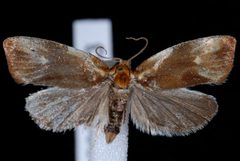
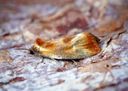
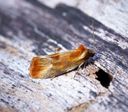
Distinguished from similar tortricids by the combination of pale ochreous forewings with a large triangular suffusion that is often pale-centred, deep ferruginous terminal streak, and the ferruginous-ochreous with prominent crest. The anteriorly narrowed forewing shape and dark ferruginous-fuscous cilia are additional diagnostic features. The overall 'brassy' appearance gives rise to its .
Images
Appearance
have a wingspan of 18–24 mm. The is dark fuscous. The is ferruginous-ochreous with a large crest. The forewings are narrowed anteriorly and pale ochreous in ground color, with deep ferruginous markings at the base of the , a large often pale-centred triangular suffusion, and a terminal streak. The cilia are dark ferruginous-fuscous. The hindwings are grey with a darker termen. The larva is light green with a brown head.
Habitat
Deciduous woodlands, forest edges, and shrubby supporting plants. Has been documented in subarctic forests and shows sensitivity to severe industrial pollution, with declining in heavily polluted areas.
Distribution
Palearctic and Nearctic realms. Documented from Belgium (including Brussels-Capital Region, Flemish Region, and Walloon Region). Records from northwestern Russia (Monchegorsk area).
Seasonality
are on wing from May to June. One per year ().
Diet
Larvae feed on leaves of various deciduous trees and shrubs: Betula pendula (silver birch), Rhamnus cathartica (common buckthorn), Corylus avellana (common hazel), and Castanea sativa (sweet chestnut). Feeding occurs within rolled or tied leaves.
Host Associations
- Betula pendula - larval plantsilver birch
- Rhamnus cathartica - larval plantcommon buckthorn
- Corylus avellana - larval plantcommon hazel
- Castanea sativa - larval plantsweet chestnut
Life Cycle
One per year. stage not explicitly documented in available sources. Larvae are present on plants during the growing season, developing as leaf-rollers. emerge in late spring.
Behavior
Larvae construct leaf rolls or ties on plants for shelter and feeding. are attracted to traps, facilitating monitoring.
Ecological Role
Herbivore in deciduous woodland . serves as an indicator of environmental quality; the has been used to study insect responses to industrial pollution.
Human Relevance
Used as a study organism for assessing insect responses to environmental pollution. Population monitoring via trapping has been employed in ecological research. Larval feeding on cultivated trees (hazel, chestnut) may occasionally bring it into contact with forestry and horticulture.
Similar Taxa
- Cochylis spp.Similar size and tribe (Cochylini); distinguished by forewing pattern and coloration, particularly the distinctive ferruginous suffusion of E. ministrana
- Other Eulia species-level similarity; requires examination of genitalia and detailed wing pattern for definitive identification