
Clepsis penetralis
Razowski, 1979
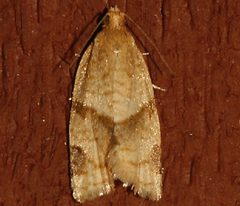
Clepsis penetralis is a small tortricid described by Razowski in 1979. It occurs in western and northeastern North America, with records from Utah, Colorado, Vermont, Washington, and southern Canada including Alberta. are active from late June through early September. The belongs to a whose larvae typically roll or tie leaves for shelter.
Pronunciation
How to pronounce Clepsis penetralis: //ˈklɛpsɪs pɛˈnɛˌtrælɪs//
These audio files are automatically generated. While they are not always 100% accurate, they are a good starting point.
Identification
Small size (forewings 6–7.5 mm) distinguishes it from larger tortricids. Separation from such as Clepsis peritana requires examination of genitalia or other subtle morphological features not detailed in general references. Geographic distribution may help narrow possibilities, though range overlap with other Clepsis occurs.
Images
Appearance
Forewing length 6–7.5 mm. As a member of the leafroller Tortricidae, it likely has the characteristic bell-shaped resting posture with wings folded roof-like over the body. Specific coloration and pattern details are not documented in available sources.
Distribution
Recorded from Utah, Colorado, Vermont, Washington, and southern Canada (Alberta). The disjunct distribution suggests either a broader range with under-sampling or isolated in western and northeastern regions of North America.
Seasonality
on wing from late June to early September.
Behavior
are attracted to light, based on collection records and standard tortricid .
Similar Taxa
- Clepsis peritanaSimilar size and appearance; both occur in western North America. Requires detailed examination to distinguish.
- Other Clepsis speciesMany share small size and general tortricid ; identification to often requires examination.
More Details
Taxonomic note
Described by Józef Razowski in 1979, a in Tortricidae .
Data limitations
Fewer than 25 iNaturalist observations and limited published biological information indicate this remains poorly known.
Sources and further reading
- BugGuide
- Wikipedia
- GBIF taxonomy match
- iNaturalist taxon
- NCBI Taxonomy
- Catalogue of Life
- Blacklighting at the Bohart: They Saw the Light | Bug Squad
- What Will You See at Bohart Museum Open House | Bug Squad
- Oh, What a (Moth) Night! | Bug Squad
- Mark Your Calendar for 'Moth Night' at Bohart Museum: July 30 | Bug Squad
- A Night at the Bohart Museum: Moth Night on Saturday, July 22 | Bug Squad
- Bug Eric: National Moth Week Recap for Colorado Springs