
Choristoneura pinus
Freeman, 1953
jack pine budworm, Jack Pine Budworm Moth
Choristoneura pinus, the jack pine budworm, is a tortricid native to North American jack pine forests. First described by Freeman in 1953, this undergoes periodic that defoliate Pinus banksiana stands across Canada and the northern United States. Larval survival depends critically on the availability of pollen cones during spring . The species exhibits lagged -dependent dynamics with its tree, contributing to outbreak cycles of 6–12 year intervals.
Pronunciation
How to pronounce Choristoneura pinus: /kɔˌrɪstoʊˈnʊərə ˈpaɪnəs/
These audio files are automatically generated. While they are not always 100% accurate, they are a good starting point.
Identification
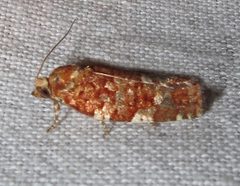
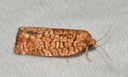
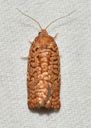
have forewings with variable gray-brown mottling and a wingspan of 18–24 mm in males and 15–28 mm in females. Larvae possess seven instars, with capsule measurements useful for distinguishing from the closely related spruce budworm (Choristoneura fumiferana); the postclypeal index provides a rapid field identification method.
Images
Habitat
Jack pine (Pinus banksiana) forests; associated with stands of varying age structure, though are more frequent in older, larger trees with lower stem .
Distribution
Canada from Atlantic provinces west to Cypress Hills on the Alberta-Saskatchewan border; northern United States from New England west to the lake states (Michigan, Wisconsin, Minnesota).
Seasonality
are active from June to August. occurs as second-instar larvae within . Spring and of larvae coincides with pollen cone availability on trees.
Diet
Larvae feed on jack pine (Pinus banksiana) foliage. First-instar larvae scrape needle surfaces; second-instar larvae establish feeding sites preferentially in pollen cones (microsporangiate strobili) before transitioning to current-year needles.
Host Associations
- Pinus banksiana - primary Pollen cones provide critical for early-instar larvae; foliar nitrogen and monoterpene content affect larval survival and weight
Life Cycle
are laid on trees. Larvae develop through seven instars, as second-instar larvae in silk . Spring timing is tied to pollen cone availability. occurs in late spring to early summer. emerge in June–August. time is one year.
Behavior
First-instar larvae actively feed rather than remaining as previously believed. Larvae disperse by ballooning on silk threads during spring ; losses are greatest in stands with few pollen cones. exhibit -dependent collapse associated with resource depletion and increased .
Ecological Role
Defoliator of jack pine forests; periodic create disturbance dynamics that interact with fire regimes. Heavy defoliation reduces tree pollen cone production, generating lagged negative feedback on budworm . Accumulation of dead and top-killed trees contributes to fuel loading and intense wildfire potential, followed by prolific jack pine .
Human Relevance
Managed as a forest pest due to timber impacts; subject to research including viral biocontrol agents (CfMNPV) and agonists (tebufenozide). monitoring and prediction efforts support in commercial forestry.
Similar Taxa
- Choristoneura fumiferanaClosely related spruce budworm with similar appearance and ; distinguished by association (primarily Abies balsamea and Picea spp.) and subtle morphological differences in larval capsule proportions
- Choristoneura conflictanaLarge aspen tortrix with overlapping ; distinguished by association (Populus tremuloides, willow, alder) and geographic distribution
Sources and further reading
- BugGuide
- Wikipedia
- GBIF taxonomy match
- iNaturalist taxon
- NCBI Taxonomy
- Catalogue of Life
- This Artificial Diet May Make Insect Rearing Easier
- Bug Eric: My Personal National Moth Week, 2017
- One of North America’s rarer longhorned beetles | Beetles In The Bush
- Researchers Propose Standardized Naming of Lab-Reared Insect Stocks
- First internet image of Phaenops piniedulis | Beetles In The Bush
- The lesser of two jewels | Beetles In The Bush
- FEEDING BEHAVIOUR OF THE FIRST-INSTAR CHORISTONEURA FUMIFERANA AND CHORISTONEURA PINUS PINUS (LEPIDOPTERA: TORTRICIDAE)
- A MICROSPORIDIAN INFECTION IN THE JACK-PINE BUDWORM, CHORISTONEURA PINUS FREE.
- A lagged, density‐dependent relationship between jack pine budworm Choristoneura pinus pinus and its host tree Pinus banksiana
- SAMPLING OVERWINTERING JACK PINE BUDWORM, CHORISTONEURA PINUS PINUS FREE. (LEPIDOPTERA: TORTRICIDAE), AND TWO OF ITS PARASITOIDS (HYMENOPTERA)
- A review of factors affecting the population dynamics of jack pine budworm (Choristoneura pinus pinus Freeman)
- PARASITISM IN SUSTAINED AND COLLAPSING POPULATIONS OF THE JACK PINE BUDWORM, CHORISTONEURA PINUS PINUS FREE. (LEPIDOPTERA: TORTRICIDAE), IN ONTARIO, 1985–1987
- Effects of nitrogen fertilization on young jack pine (Pinus banksiana) and on its suitability as a host for jack pine budworm (Choristoneura pinus pinus) (Lepidoptera: Tortricidae)
- THE NUMBER OF INSTARS IN JACK PINE BUDWORM, CHORISTONEURA PINUS PINUS FREE. (LEPIDOPTERA: TORTRICIDAE), AND THE EFFECT OF PARASITISM ON HEAD CAPSULE WIDTH AND DEVELOPMENT TIME
- Analysis of Frequency Distribution of Adults and Larvae of Choristoneura fumiferana (Clem.) and C. pinus Free. (Lepidoptera: Tortricidae)
- Host‐plant influence on the population ecology of the jack pine budworm, Choristoneura pinus (Lepidoptera: Tortricidae)