
Argyrotaenia quadrifasciana
(Fernald, 1882)
Four-lined Leafroller Moth, Four-banded Leafroller, Lesser All-green Leafroller
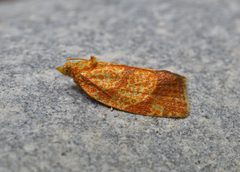
A small tortricid native to North America, recognized by the four pale transverse lines on its forewings. are active from May to August, with one per year. The overwinters as a third-instar larva and is associated with orchards and shrubby . Larvae feed on leaves of various woody plants in the rose .
Pronunciation
How to pronounce Argyrotaenia quadrifasciana: /ˌɑːr.d͡ʒɪ.roʊˈteɪ.ni.ə ˌkwɑː.drɪ.fæˈʃaɪ.ə.nə/
These audio files are automatically generated. While they are not always 100% accurate, they are a good starting point.
Identification
Distinguished from other Argyrotaenia by the four distinct pale transverse lines on the forewings. The Red-banded Leafroller (Argyrotaenia velutinana) has a prominent reddish-brown band rather than multiple transverse lines. Other similar tortricids in the same may show different banding patterns or fewer lines. Examination of genitalia may be required for definitive identification in some cases.
Images
Appearance
Small with wingspan of 14–17 mm. Forewings display four distinct pale transverse lines against a darker background, giving the its . Wing pattern consists of alternating light and dark bands. Overall coloration ranges from brown to grayish-brown with cream or whitish markings.
Habitat
Orchards and shrubby areas, particularly where plants of the rose occur. Associated with both cultivated and wild stands of Amelanchier, Crataegus, Malus, Prunus, and Pyrus.
Distribution
North America: Nova Scotia to West Virginia, west to Arkansas, and north to Alberta. Records from Canadian provinces including Alberta, Manitoba, and Saskatchewan, and U.S. state of Vermont.
Seasonality
recorded on wing from May to August. One per year. Overwinters as third-instar larva.
Diet
Larvae feed on leaves of Amelanchier (including A. alnifolia), Crataegus species, Malus sylvestris, Prunus species (including P. pensylvanica, P. serotina, P. virginiana), and Pyrus species. feeding habits not documented.
Host Associations
- Amelanchier alnifolia - larval
- Prunus pensylvanica - larval
- Prunus serotina - larval
- Prunus virginiana - larval
- Malus sylvestris - larval
- Crataegus - larval level
- Pyrus - larval level
- Amelanchier - larval level
- Prunus - larval level
Life Cycle
Holometabolous with complete . One per year. hatch into larvae that feed on plant leaves. Larvae overwinter in the third instar. occurs in spring, with emerging from May through August. Specific details of egg-laying and pupation sites not documented.
Behavior
Larvae are leafrollers, constructing shelters by rolling or folding leaves. are and have been recorded at blacklight. Specific adult such as mating or oviposition not documented.
Ecological Role
Herbivore in orchard and shrubland . Larvae consume leaves of woody plants, potentially contributing to minor defoliation. Role in as prey for and not documented.
Human Relevance
Occasional pest in orchards due to larval feeding on cultivated Malus (apple) and Pyrus (pear). Economic impact appears limited compared to other tortricid pests. No significant cultural or medicinal uses documented.
Similar Taxa
- Argyrotaenia velutinanaRed-banded Leafroller has a prominent reddish-brown band rather than four transverse lines; also more and widespread in eastern North America
- Other Argyrotaenia speciesMany share similar size and general wing pattern but differ in number, arrangement, or color of transverse lines; genitalia examination often required for definitive separation
More Details
Taxonomic History
Originally described as Lophoderus quadrifasciana by Fernald in 1882 before transfer to Argyrotaenia.