
Argyrotaenia mariana
(Fernald, 1882)
gray-banded leafroller moth
Argyrotaenia mariana is a small tortricid known as the gray-banded leafroller moth. The occurs across eastern and central North America, with active from spring through summer. Larvae feed on a diverse array of woody plants including maples, birches, oaks, apples, and blueberries. The species was first described by Fernald in 1882 under the name Lophoderus mariana.
Pronunciation
How to pronounce Argyrotaenia mariana: /ˌɑːrɡɪrəˈtiːniə məˈriːɑːnə/
These audio files are automatically generated. While they are not always 100% accurate, they are a good starting point.
Identification
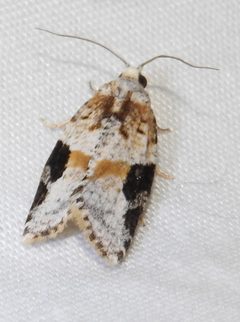
The gray-banded forewing pattern distinguishes this from other Argyrotaenia. The small size (20 mm wingspan) and spring-to-summer period help separate it from similar leafroller species. Examination of genitalia may be required for definitive identification from closely related species.
Images
Appearance
have a wingspan of approximately 20 mm. The forewings display gray banding patterns characteristic of the name. As a member of the leafroller group, adults possess the typical tortricid resting posture with wings held roof-like over the body.
Habitat
Associated with deciduous forests and wooded areas where plants occur. Larval includes the foliage and twigs of diverse woody angiosperms.
Distribution
Eastern and central North America: recorded from Connecticut, Florida, Georgia, Illinois, Indiana, Kentucky, Maine, Maryland, Massachusetts, New Brunswick, New Hampshire, New York, North Carolina, Ohio, Ontario, Pennsylvania, Quebec, Tennessee, and West Virginia. Additional records from Alberta, Manitoba, and Saskatchewan in Canada.
Seasonality
have been recorded on wing from March to August, with peak activity likely varying by latitude.
Diet
Larvae feed on leaves of multiple woody plant including: Acer (maples), Alnus (alders), Betula (birches including B. alleghaniensis, B. papyrifera, B. populifolia), Kalmia angustifolia, Malus (apples including M. pumila, M. sylvestris), Populus tremuloides, Prunus virginiana, Pyrus (pears), Quercus (oaks), Salix (willows), Ulmus americana, Vaccinium (blueberries including V. uliginosum), Viburnum species, and Prenanthes species (including P. trifoliata).
Host Associations
- Acer - larval food plant
- Alnus - larval food plant
- Betula alleghaniensis - larval food plant
- Betula papyrifera - larval food plant
- Betula populifolia - larval food plant
- Kalmia angustifolia - larval food plant
- Malus pumila - larval food plant
- Malus sylvestris - larval food plant
- Populus tremuloides - larval food plant
- Prunus virginiana - larval food plant
- Pyrus - larval food plant
- Quercus - larval food plant
- Salix - larval food plant
- Ulmus americana - larval food plant
- Vaccinium uliginosum - larval food plant
- Viburnum - larval food plant
- Prenanthes trifoliata - larval food plant
Life Cycle
Complete with , larval, pupal, and stages. Larvae are leafrollers, constructing shelters by folding or rolling leaves. Specific details of stage and number of per year are not documented.
Behavior
Larvae exhibit leaf-rolling , feeding within constructed shelters. are and attracted to light.
Ecological Role
Herbivore in deciduous forest . Larvae process foliage of diverse woody plants, contributing to nutrient cycling. The ' broad range suggests it functions as a herbivore rather than a specialized pest.
Human Relevance
Larvae feed on apple (Malus) and pear (Pyrus), indicating potential occasional pest status in orchards, though not documented as a major agricultural pest. The is primarily of ecological interest.
Similar Taxa
- Argyrotaenia velutinanaRed-banded leafroller moth; similar size and habits but with red rather than gray forewing bands, and broader geographic range (east of Rocky Mountains)
- Other Argyrotaenia speciesMany share leafroller habits and similar ; precise identification often requires examination of genitalia or wing pattern details
More Details
Taxonomic history
Originally described as Lophoderus mariana by Fernald in 1882, later transferred to Argyrotaenia.
iNaturalist observations
The has accumulated over 2,400 research-grade observations on iNaturalist, indicating it is frequently encountered and photographed by naturalists.