
Dichrorampha sapodilla
Heppner, 1981
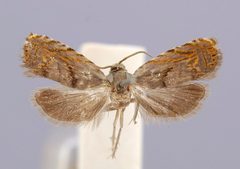
Dichrorampha sapodilla is a small in the leaf-roller Tortricidae, described by John B. Heppner in 1981. The is known only from Florida, USA, and appears to be rarely encountered, with only one documented observation in public databases. Like other members of its , it likely has a specialized association with particular plants, though specific details remain undocumented.

Pronunciation
How to pronounce Dichrorampha sapodilla: //ˌdaɪkroʊˈræmfə ˌsæpəˈdɪlə//
These audio files are automatically generated. While they are not always 100% accurate, they are a good starting point.
Identification
No specific diagnostic features distinguishing D. sapodilla from are documented in available sources. The Dichrorampha comprises small tortricid moths typically characterized by distinctive wing patterns and genitalia , but -level identification generally requires examination of genitalic structures.
Images
Distribution
Known only from Florida, USA. The precise type locality and extent of distribution within Florida are not specified in available literature.
Similar Taxa
- Dichrorampha velataBoth are small tortricid moths; D. velata is a well-studied alpine with olive-brown forewings and silvery lines, recently described from Europe after being confused with D. alpestrana for over a century. D. sapodilla differs in geographic distribution (Florida vs. European Alps) and likely preference.
- Dichrorampha alpestranaA European historically confused with D. montanana; like D. sapodilla, it is a small tortricid, but differs in distribution (Europe) and is associated with mountain meadows rather than subtropical environments.
More Details
Etymology
The specific epithet 'sapodilla' likely refers to the sapodilla tree (Manilkara zapota), suggesting a possible plant association, though this has not been confirmed.
Data Deficiency
The is extremely poorly known, with minimal collection records and no published studies on its , , or status since its original description over 40 years ago.
Sources and further reading
- BugGuide
- Wikipedia
- GBIF taxonomy match
- iNaturalist taxon
- Catalogue of Life
- New alpine moth solves a 180-year-old mystery | Blog
- Alpine Entomology | Blog - Part 2
- moth | Blog
- new species | Blog - Part 16
- Destination Caracol, Belize: Tiny scorpions on the tree bark? Nah, false scorpions, Pseudoscorpiones — Bug of the Week