
Cydia ingens
(Heinrich, 1926)
Longleaf Pine Seedworm Moth
A small tortricid native to the southeastern United States, specialized on pine seeds. are grayish-brown with distinctive metallic bars on the forewings. The is of minor economic concern due to seed damage in pine plantations.
Pronunciation
How to pronounce Cydia ingens: /ˈsiː.di.a ˈin.dʒɛns/
These audio files are automatically generated. While they are not always 100% accurate, they are a good starting point.
Identification
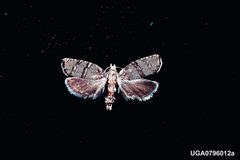
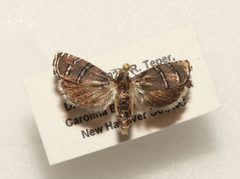
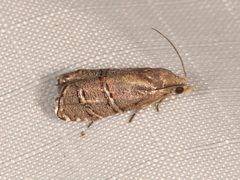
Distinguished from the similar Cydia toreuta by the broken metallic bar on the forewing (usually split into and portions) and the conspicuous black line along the silver-fringed wingtip. The dirty white coloration also aids identification.
Images
Appearance
have a wingspan of 17–20 mm. Forewings are ashy-brown with several metallic bars edged in black; one bar is usually broken into and portions. A conspicuous black line runs along the wingtip, fringed with silver. Hindwings are smoky-fuscous with a paler fringe. The is dirty white. Larvae are whitish and -like.
Habitat
Pine forests and coastal plains where pines occur. Specifically associated with longleaf pine , but also found in stands of slash pine and loblolly pine.
Distribution
Recorded in Alabama, Florida, Georgia, Mississippi, North Carolina, and South Carolina. Likely occurs throughout the natural range of Pinus palustris in the southeastern United States.
Diet
Larvae feed exclusively on pine seeds, specifically those of longleaf pine (Pinus palustris), slash pine (Pinus elliottii), and loblolly pine (Pinus taeda).
Host Associations
- Pinus palustris - primary longleaf pine
- Pinus elliottii - slash pine
- Pinus taeda - loblolly pine
Ecological Role
Seed of native pines. May reduce seed viability in natural stands and plantations, potentially affecting forest where are high.
Human Relevance
Minor pest of pine seed orchards and natural seed collection operations. Damage is generally limited and rarely warrants control measures.
Similar Taxa
- Cydia toreutaSimilar grayish-brown coloration and size, but lacks the broken metallic bar and conspicuous black wingtip line of C. ingens
Sources and further reading
- BugGuide
- Wikipedia
- GBIF taxonomy match
- iNaturalist taxon
- Catalogue of Life
- Blacklighting at the Bohart: They Saw the Light | Bug Squad
- What Will You See at Bohart Museum Open House | Bug Squad
- Like a Moth to a Flame: Moth Night at Bohart Museum of Entomology | Bug Squad
- Oh, What a (Moth) Night! | Bug Squad
- Line Trapping: A Promising Method for More Accurate Pest Monitoring
- Odorant Receptor Gene in Codling Moth Also Affects Egg Production