
Eucosma cana
(Haworth, 1811)
Hoary Bell
Eucosma cana, commonly known as the hoary bell, is a small tortricid with a wingspan of 16–23 mm. It is widespread across Europe, parts of Asia including China and Japan, and Central Asia. The is , with active from June to August. Larvae develop within the flowerheads of thistles and related plants, feeding on Cirsium, Carduus, and Centaurea nigra.


Pronunciation
How to pronounce Eucosma cana: /juːˈkɒzmə ˈkeɪnə/
These audio files are automatically generated. While they are not always 100% accurate, they are a good starting point.
Identification
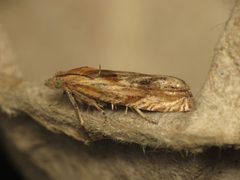
Distinguished from the similar Eucosma hohenwartiana by its lighter forewing ground colour and presence of longitudinal lighter streaks; E. hohenwartiana has darker forewings lacking these streaks. The combination of light brown or greyish forewings with longitudinal discal streaks, reddish-brown , and feathered wing edges is diagnostic.
Images
Appearance
Body length approximately 11.5 mm. reddish-brown. light brownish on sides, dark brownish in middle. Forewings elongate, ground colour light brown or greyish with light longitudinal discal streaks; edges feathered; half of with very oblique whitish strigulae, abruptly ceasing at one-third; ocellus metallic-edged with one or two incomplete black dashes; termen sinuate. Hindwings dark gray toward margins; in male pale grey with darker terminal area, in female darker overall.
Habitat
Flower meadows, rough grounds, and waysides. Associated with supporting thistle .
Distribution
Most of Europe; China (Zhejiang, Fujian, Henan, Guangdong, Yunnan, Shaanxi, Gansu, Xinjiang); Japan; Central Asia; Russia; Kazakhstan.
Seasonality
on wing June to August in a single . Larvae present August to May.
Diet
Larvae feed on flowerheads of Cirsium , Carduus species, and Centaurea nigra (black knapweed). diet not documented.
Host Associations
- Cirsium - larval flowerheads
- Carduus - larval flowerheads
- Centaurea nigra - larval flowerheads
Life Cycle
. emerge June–August. Larvae develop within thistle flowerheads from August through May, reaching 10–11 mm in length; pale orange or dark ocher, broad and somewhat flat in form. occurs within the flowerhead or surrounding substrate.
Ecological Role
Herbivore; larval feeding on thistle flowerheads may influence seed production of plants. Part of the supporting and of tortricid larvae.
Human Relevance
Not a significant pest of economic crops; primarily associated with wild thistles. Presence in flower meadows may indicate quality for -associated plants.
Similar Taxa
- Eucosma hohenwartianaSimilar size and general appearance, but distinguished by darker forewing ground colour and absence of longitudinal lighter streaks present in E. cana.
Sources and further reading
- BugGuide
- Wikipedia
- GBIF taxonomy match
- iNaturalist taxon
- Catalogue of Life
- The ants, bees and wasps of Canada, Alaska and Greenland – a checklist of 9250 species | Blog
- Non-native pest-controlling wasp in Canada | Blog
- Eaters of thistles: Thistle tortoise beetle, Cassida rubiginosa, and Canada thistle bud weevil, Larinus planus — Bug of the Week
- Bug Eric: Wasp Wednesday: Ampulex canaliculata
- Civil engineering legacy provides habitats for threatened fish
- Exploring arctic plants and lichens