
Eucopina cocana
(Kearfott, 1907)
Shortleaf Pine Coneborer Moth
Eucopina cocana, commonly known as the Shortleaf Pine Coneborer , is a small tortricid moth in the Olethreutinae. The is associated with pine cones, specifically those of shortleaf pine (Pinus echinata), and develops as a larval borer within cone tissues. are small, nondescript moths with wingspans typical of the . The species is documented primarily from the southeastern United States where its tree occurs.
Pronunciation
How to pronounce Eucopina cocana: /ɛu̯.koːˈpiː.na koˈkaː.na/
These audio files are automatically generated. While they are not always 100% accurate, they are a good starting point.
Identification
Distinguished from other Eucopina by association with Pinus echinata cones and by genitalia characters: male valvae with specific spine patterns on the cucullus, and female with characteristic signum shape in the corpus bursae. Forewing pattern alone is insufficient for reliable identification; dissection or molecular analysis may be required to separate from E. siskiyouana and other closely related species. The reflects the association, which aids in field recognition where host trees are present.
Images
Appearance
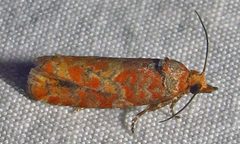
are small with forewings ranging from grayish to brownish in ground color, often with indistinct darker markings. The wings are relatively narrow and elongated, typical of Olethreutinae. Labial palps are prominent and project forward. Genitalia distinguishes this from , with specific configurations of the male valvae and female sterigma. Larvae are small, cream-colored to pale yellow with a dark capsule, adapted for boring within cone tissues.
Habitat
Associated with forests and woodlands containing shortleaf pine (Pinus echinata), particularly in upland and mixed pine-hardwood . Larval is restricted to developing pine cones.
Distribution
Southeastern United States, primarily within the natural range of Pinus echinata: documented from states including Arkansas, Missouri, Oklahoma, Texas, Louisiana, Mississippi, Alabama, Georgia, Florida, South Carolina, North Carolina, Virginia, Kentucky, Tennessee, and West Virginia.
Seasonality
period has been observed primarily in spring and early summer, with peak activity typically April through June; this coincides with cone development on trees. Specific timing varies with latitude and seasonal conditions.
Diet
Larvae feed internally on tissues of developing Pinus echinata cones, including and seeds. The feeding damage destroys cone tissues and prevents seed development.
Host Associations
- Pinus echinata - larval Primary ; larvae develop within cones of shortleaf pine
Life Cycle
Complete with four stages: , larva, pupa, . Eggs are deposited on or near developing cones. Larvae bore into cones and feed internally, passing through multiple instars. occurs within the cone or in nearby debris. Adults emerge to mate and oviposit during the 's cone development period. time is likely one year, though this has not been rigorously documented.
Behavior
Larvae are concealed feeders, tunneling within cone tissues and producing that may be visible at cone entry points. are and attracted to light. Mating and oviposition are poorly documented but likely occur on or near trees during evening hours.
Ecological Role
Acts as a seed of Pinus echinata, reducing seed production in infested cones. May serve as prey for cone-feeding birds and . impacts on tree are generally minor except during localized .
Human Relevance
Minor economic significance as a pest of shortleaf pine seed production in seed orchards and natural stands managed for timber or . Not considered a serious forestry pest. Of interest to lepidopterists studying pine-feeding tortricid diversity.
Similar Taxa
- Eucopina siskiyouanaSimilar genitalia and forewing pattern; distinguished by geographic range (western North America) and association with different Pinus
- Eucopina gloveranaAnother pine cone-boring Eucopina; separated by preference and subtle genitalia differences
- Eucopina euryleucaOverlapping range and similar appearance; requires genitalia examination for definitive identification