
Epinotia nisella
(Clerck, 1759)
Grey Poplar Bell, Yellow-headed Aspen Leaftier
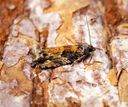
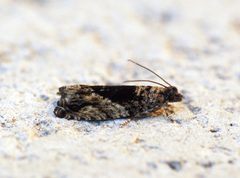
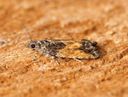
Epinotia nisella is a small tortricid with a Holarctic distribution across northern Eurasia and northern North America. First described by Clerck in 1759, it is highly polymorphic in forewing coloration, showing extensive variation in grey, black, and brown patterns. The is closely related to E. cinereana, from which it was recently reinstated as distinct based on barcodes and genital . Larvae feed on catkins and leaves of Populus and Salix species.
Pronunciation
How to pronounce Epinotia nisella: /ˌɛpɪˈnoʊʃə nɪˈsɛlə/
These audio files are automatically generated. While they are not always 100% accurate, they are a good starting point.
Identification
Distinguished from the similar E. cinereana by male and female genitalia structure and barcodes; North American show moderate barcode divergence from European populations but no correlated morphological differences. Forewing pattern highly variable, with multiple color morphs previously described as separate . Distinguished from other Epinotia by combination of angulated basal patch edge, presence of ferruginous blotch, and leaden-metallic ocellus markings.
Images
Appearance
Small with wingspan 12–17 mm. Forewings grey, variably mixed with white and slightly ferruginous-tinged, irregularly strigulated with blackish-grey. Basal patch darker with blackish, acutely angulated edge. Often with ferruginous or red-brown flattened-triangular blotch to basal patch. Central fascia slender, irregular, somewhat darker. Ocellus edges sometimes leaden-metallic; termen sinuate. Hindwings light fuscous, darker terminally. Larva pale green with dark brown . Highly variable in forewing pattern; some individuals suffused with ferruginous except basal and terminal patches.
Habitat
Woodlands, parks, and damp places where plants occur. Associated with stands of Populus and Salix, particularly rough-leaved .
Distribution
Holarctic: most of Europe (except Iceland, Portugal, Ukraine, and central Balkan Peninsula), east to Near East and eastern Palearctic. In North America: from Newfoundland to British Columbia in Canada; Massachusetts and Minnesota in the United States.
Seasonality
active July through August (or July to September in some regions). Larvae feed April to June. Overwinters as or small larva.
Diet
Larva feeds in female catkins of Populus , primarily between spun leaves or within catkins. Has been observed boring in current-growth branchlets of P. balsamifera when available.
Host Associations
- Populus tremula - larval aspen
- Populus nigra - larval black poplar
- Populus × canescens - larval grey poplar
- Populus tremuloides - larval quaking aspen; primary North American
- Populus balsamifera - larval balsam poplar; larvae bore in branchlets
- Salix cinerea - larval grey willow
- Salix caprea - larval goat willow
Life Cycle
Overwinters as or small larva. Larval feeding period April to June, occurring in catkins or between spun leaves; may also bore in current-growth branchlets. occurs in larval habitation or in flimsy, brownish, silken cocoon amongst leaf litter during June and July. emerge July to August/September.
Behavior
fly from dusk and come to light. By day, adults rest on foliage or amongst lichen on tree trunks of larval foodplants. When disturbed, flies erratically to another resting place. Shows feeding plasticity: larvae can switch between feeding in female catkins and boring in current-growth branchlets depending on availability and branchlet thickness.
Similar Taxa
- Epinotia cinereanaFormerly synonymized with E. nisella but reinstated as distinct based on barcodes and genital ; both occur in Holarctic region
- Proteopteryx criddleanaJunior synonym of E. cinereana, not E. nisella; historically confused with E. nisella in North America
Misconceptions
Long treated as with E. cinereana; the two were separated based on genetic and morphological evidence, with multiple synonyms of E. nisella reflecting its highly variable forewing pattern rather than distinct species.
More Details
Genomic resources
Chromosomally complete assembly of 585.0 Mb available from Darwin Tree of Life Project, with 28 chromosomal pseudomolecules (27 + Z ), 15.44 kb mitochondrial genome, and 18,952 protein-coding genes.
Taxonomic history
Tortrix petrana Hübner, 1813 and other names previously associated with this are now placed with E. cinereana. Epinotia nisella has accumulated several synonyms due to its polymorphic forewing coloration.
Sources and further reading
- BugGuide
- Wikipedia
- GBIF taxonomy match
- iNaturalist taxon
- NCBI Taxonomy
- Catalogue of Life
- My Publications | Beetles In The Bush
- <i>Epinotia Nisella</i>: an Unrecorded Host and Mode of Feeding (Lepidoptera: Tortricidae)
- Epinotia cinereana (Haworth, 1811) bona sp., a Holarctic tortricid distinct from E. nisella (Clerck, 1759) (Lepidoptera: Tortricidae: Eucosmini) as evidenced by DNA barcodes, morphology and life history
- The genome sequence of the Grey Poplar Bell, Epinotia nisella (Clerck, 1759).