
Epinotia meritana
Heinrich, 1923
white-fir needle miner
Epinotia meritana is a small tortricid whose larvae are specialized miners of fir needles. The completes one annually, with active in mid-summer and larvae feeding internally on white fir foliage before within mined needles. It occurs in western North American conifer forests where its trees grow.
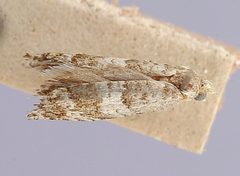
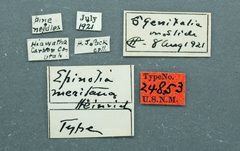
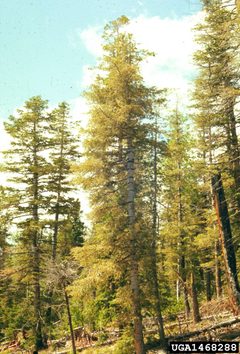
Pronunciation
How to pronounce Epinotia meritana: //ˌɛpɪˈnoʊʃə ˌmɛrɪˈtɑːnə//
These audio files are automatically generated. While they are not always 100% accurate, they are a good starting point.
Identification
Distinguished from other Epinotia by association with Abies concolor and Abies magnifica as , and by the distinctive needle-mining damage pattern. are small (9 mm wingspan) and active in late June and July. Larval presence confirmed by discolored, hollowed needle tissue. Specific morphological characters for separation from require examination.
Images
Habitat
Forests dominated by white fir (Abies concolor) and red fir (Abies magnifica). Oviposition occurs preferentially on 3–5 year old needles. Tops of codominant trees experience the heaviest damage. The occupies montane and subalpine coniferous forest zones in the western United States.
Distribution
Western United States including Utah, New Mexico, Arizona, and Colorado. Distribution corresponds with the range of its primary , white fir (Abies concolor).
Seasonality
on wing from mid-June through mid-August, with peak activity in late June and July in New Mexico and Arizona. One per year. Larvae present from late July through following spring, with occurring May–June.
Diet
Larvae feed internally by mining needles of Abies concolor (white fir) and Abies magnifica (red fir). They consume tissue of needles one or more years old and generally do not move to foliage of a different age class.
Host Associations
- Abies concolor - primary white fir; larvae mine needles of all ages but oviposition concentrated on 3–5 year old foliage
- Abies magnifica - red fir; larvae recorded mining needles
Life Cycle
. emerge mid-June to mid-August and oviposit on concave side of needle bases. hatch late July–August. Larvae enter needles, mine one or more year-old foliage, and overwinter within the first or second mined needle. In spring, each larva mines one or two additional needles before pupating in the final mined needle during May or June. Adults emerge to complete the cycle.
Behavior
Larvae are endophagous needle miners, completing development within foliage without exiting until . They exhibit fidelity to needle age class, generally remaining within the year's foliage where they initially established. occurs inside the protected needle mine. Oviposition targets the concave needle surface near the base.
Ecological Role
herbivore and defoliator of white fir. Causes damage across all tree age classes, with greatest impact on upper crowns of codominant trees. includes by Apanteles (Braconidae), which causes approximately 11% larval mortality in observed . Contributes to nutrient cycling through needle and modifies plant architecture in situations.
Human Relevance
Recognized as a forest pest causing defoliation of white fir in western North American forestry. Damage is concentrated in tree crowns and can affect tree vigor. Subject of biological study for understanding tortricid- specialization and in coniferous .
Similar Taxa
- Other Epinotia speciesMany Epinotia are needle or bud miners on conifers; separation requires association data and genitalia examination
- Other Olethreutinae tortricidsShare similar size and ; larval and mine characteristics provide better identification than features alone
More Details
Parasitoid pressure
Apanteles (Braconidae) is the most prevalent observed, causing approximately 11% larval mortality in studied Colorado .
Damage patterns
Defoliation affects all age classes of white fir but is most severe on tops of codominant trees, suggesting microhabitat or physiological factors influence selection outcomes.