
Enarmonia formosana
(Scopoli, 1763)
cherry-bark moth, cherry bark tortrix, cherrybark tortrix
A small tortricid native to Europe, Asia, and North Africa, with introduced in North America. are active from May to October in temperate regions. Larvae tunnel beneath bark of mature Rosaceae trees, producing reddish at tunnel entrances. The serves as for multiple hymenopterous in Europe and is managed using synthetic in North America.
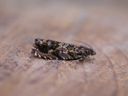
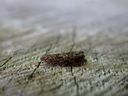
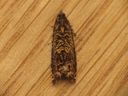
Pronunciation
How to pronounce Enarmonia formosana: //ɛˌnɑːrˈmoʊniə ˌfɔːrmoʊˈsɑːnə//
These audio files are automatically generated. While they are not always 100% accurate, they are a good starting point.
Images
Habitat
Mature trees in rosaceous orchards, woodlands, and ornamental plantings; prefers woody Rosaceae of Amygdaloideae. Larval tunnels occur at bark cracks, branch joints, and canker . Distribution in Central Europe correlates with isotherms of 8–9°C and 10–11°C, with zonal exceptions.
Distribution
Native to most of Europe, extending east through Asia to Siberia and Kazakhstan, and south to the Maghreb in North Africa. Introduced established in North America (including British Columbia) and possibly Asia Minor. In Central Europe, occurrence is disjunct with tree distribution patterns.
Seasonality
fly from May to October in temperate regions such as Belgium and the Netherlands.
Diet
Larvae feed beneath bark of woody Rosaceae in Amygdaloideae: hawthorns (Crataegus), apples (Malus), cherries and plums (Prunus), pears (Pyrus), and rowans (Sorbus). Larvae specifically forage at canker on mature trees.
Life Cycle
laid on bark. Larvae tunnel beneath bark, producing reddish at tunnel entrances; feeding signs visible at bark cracks and branch joints. Larva creamy white with orange-brown . occurs at tunnel entrance, often enclosed by frass secured with silk. emerge through exit holes. Two to three per year have been reported for related bark-feeding tortricids, but specific generation count for this is not documented.
Behavior
Larvae produce conspicuous reddish at tunnel entrances. are and attracted to specific blends. Both sexes antennally detect and behaviorally avoid nonhost volatiles: nonanal from trembling aspen and α-pinene from conifers reduce male trap captures and deter female oviposition. This avoidance may provide concealment from during calling, resting, and copulation.
Ecological Role
Serves as for hymenopterous including ichneumonids (Campoplex cf. dubitator, Liotryphon sp., Lissonotus sp., Pimpla spuria, Pimpla turionellae) and braconids (Apanteles britannicus) in central-east Europe. Larval tunneling contributes to bark decomposition and nutrient cycling in mature rosaceous trees.
Human Relevance
Pest of rosaceous fruit and ornamental trees. Managed in North America using synthetic for mass trapping or male disruption; a 10-mg blend of (E)-9-dodecenyl acetate and (Z)-9-dodecenyl acetate (50:50 or 40:60 ratio) captures more males than virgin females. programs have surveyed European for potential introduction. Risk of spread via movement of plant material; recommended for sweetgum imports from China to prevent accidental transport of associated pests.
Sources and further reading
- BugGuide
- Wikipedia
- GBIF taxonomy match
- iNaturalist taxon
- NCBI Taxonomy
- Catalogue of Life
- American Sweetgum Picks Up a Beetle Pest in China
- SEX PHEROMONE COMPONENTS OF ENARMONIA FORMOSANA (LEPIDOPTERA: TORTRICIDAE)
- Cherry Bark Tortrix, Enarmonia formosana: Olfactory Recognition of and Behavioral Deterrence by Nonhost Angio- and Gymnosperm Volatiles
- Hymenopterous parasitoids of the cherry bark tortrix, Enarmonia formosana (Scopoli) in central‐east Europe (Hymenoptera, Ichneumonoidea; Lepidoptera, Tortricidae)
- Distribution, habitats and host plants of the cherry bark tortrix, Enarmonia formosana (Scopoli) in the Czech Republic (Lepidoptera, Tortricidae)