
Enarmonia
Hübner, [1825], 1816
cherry bark tortrix (E. formosana)
Species Guides
1- Enarmonia formosana(cherry-bark moth)
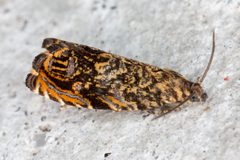
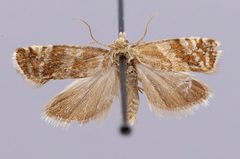
Enarmonia is a of tortricid moths in the Olethreutinae. The genus contains approximately six described , with Enarmonia formosana (cherry bark tortrix) being the most extensively studied due to its economic significance as a pest of Prunus species. Larvae develop as concealed feeders under bark, mining the cambium layer. are active in spring and communicate via species-specific .
Pronunciation
How to pronounce Enarmonia: //ɛn.ɑːrˈmoʊ.ni.ə//
These audio files are automatically generated. While they are not always 100% accurate, they are a good starting point.
Images
Habitat
Associated with rosaceous trees and shrubs, particularly Prunus . Larvae inhabit the space beneath bark, mining in the cambium layer. use trees for calling, resting, copulation, and oviposition.
Distribution
Palearctic distribution. Documented in central-east Europe (Czech Republic, Slovakia, Hungary, Poland, Austria, Germany), Scandinavia (Denmark, Norway, Sweden), and introduced to North America (British Columbia). Distribution approximates isotherms of 8–11°C with zonal exceptions.
Seasonality
emerge in spring.
Diet
Larvae feed beneath bark of trees, mining in the cambium layer.
Host Associations
- Prunus avium - sweet cherry; key target association
- Prunus cerasus - sour cherry
- Prunus armeniaca - apricot
- Prunus domestica - plum
- Prunus persica - peach
- Prunus divaricata - wild almond
- Prunus serrulata - flowering cherry
Life Cycle
Larvae develop concealed under bark. occurs in silken cocoons located in bark crevices or in soil. emerge in spring.
Behavior
Larvae are concealed feeders under bark. Both sexes detect and avoid nonhost plant volatiles including nonanal (from aspen) and α-pinene (from conifers), which deter males from traps and females from oviposition. Calling, resting, and copulation occur on trees.
Ecological Role
Herbivore of rosaceous trees. Serves as for diverse hymenopterous complex including 25+ ichneumonid and 4+ braconid species. Nonhost volatile recognition may reduce competition and risk by enabling avoidance of unsuitable trees.
Human Relevance
E. formosana is a significant pest of cherry orchards. Synthetic (E9-12:OAc and Z9-12:OAc blends) are under evaluation for mass trapping and male disorientation as management strategies.
Sources and further reading
- BugGuide
- Wikipedia
- GBIF taxonomy match
- iNaturalist taxon
- NCBI Taxonomy
- Catalogue of Life
- SEX PHEROMONE COMPONENTS OF ENARMONIA FORMOSANA (LEPIDOPTERA: TORTRICIDAE)
- Cherry Bark Tortrix, Enarmonia formosana: Olfactory Recognition of and Behavioral Deterrence by Nonhost Angio- and Gymnosperm Volatiles
- Hymenopterous parasitoids of the cherry bark tortrix, Enarmonia formosana (Scopoli) in central‐east Europe (Hymenoptera, Ichneumonoidea; Lepidoptera, Tortricidae)
- Distribution, habitats and host plants of the cherry bark tortrix, Enarmonia formosana (Scopoli) in the Czech Republic (Lepidoptera, Tortricidae)