
Opogona sacchari
(Bojer, 1856)
banana moth, sugar-cane moth
Opogona sacchari is a tineid native to humid tropical and subtropical regions of sub-Saharan Africa, including Madagascar and Indian Ocean islands. It has become established in glasshouses and tropical agriculture worldwide, causing damage to bananas, pineapples, sugarcane, and numerous ornamental plants. The exhibits thermal sensitivity, with development optimal at 25°C and complete mortality above 30°C.
Pronunciation
How to pronounce Opogona sacchari: /ˌɒpəˈɡoʊnə ˈsækəri/
These audio files are automatically generated. While they are not always 100% accurate, they are a good starting point.
Identification
can be distinguished from similar tineid moths by their bright yellowish brown coloration and size. The combination of larval habits in glasshouse environments and tropical agriculture, along with the distinctive cocoon structure, aids identification. Larval damage to plant crowns and stems is characteristic.
Images
Appearance
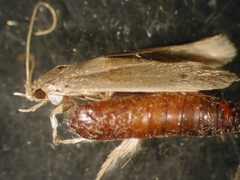
are bright yellowish brown with a wingspan of 18–25 mm. Pupae are shorter than 10 mm, brown, and formed within a cocoon approximately 15 mm in length.
Habitat
Native to humid tropical and subtropical regions. In introduced ranges, primarily found in controlled environment horticulture including glasshouses and conservatories. Can establish outdoors in tropical and Mediterranean climate zones.
Distribution
Native: sub-Saharan Africa (including Madagascar, Mauritius, Réunion, Rodrigues Island, Seychelles, St. Helena). Introduced: Canary Islands (since 1920s), Brazil and Central America (since 1970s), Europe, Florida (since 1986), and Hawaii. Established in glasshouses throughout Northern Europe including UK, Belgium, Netherlands, Germany, and others.
Diet
Larvae are , feeding on bananas, pineapples, bamboo, maize, sugarcane, and a wide range of ornamental plants including Cactaceae, Dracaena, Strelitzia, Yucca, Alpinia, Begonia, Bougainvillea, Bromeliaceae, palms, Cordyline, Dieffenbachia, Euphorbia pulcherrima, Ficus, Gloxinia, Heliconia, Hippeastrum, Maranta, Philodendron, Sansevieria, Streptocarpus sect. Saintpaulia, Capsicum, and aubergines.
Host Associations
- Musa paradisiaca - larval food plantbanana
- Ananas comosus - larval food plantpineapple
- Saccharum officinarum - larval food plantsugarcane
- Zea mays - larval food plantmaize
Life Cycle
At 15°C, the completes in approximately three months: hatch in 12 days, larval development lasts 50 days, pupal stage 20 days, and life 6 days. Development is optimal at 25°C; mortality is 100% above 30°C. The lower temperature threshold is 8.6°C.
Ecological Role
Pest in agricultural and horticultural systems. In glasshouse environments, can cause significant plant mortality and economic losses. Thermal constraints limit natural establishment to tropical and subtropical zones.
Human Relevance
Major pest of banana, pineapple, and sugarcane production. Significant pest of ornamental horticulture in glasshouses, causing plant death and requiring integrated management. Subject to regulations in several countries including Argentina. Managed through including , cultural practices, and in some contexts, sterile insect technique research.
Similar Taxa
- Opogona omoscopaCongeneric in the same Tineidae; both are pests of ornamental plants and can be found in similar glasshouse environments. Distinguished by distribution and preferences.
- Eldana saccharinaAlso a pest of sugarcane in Africa with similar (African sugarcane stalk borer), but belongs to Pyralidae, has different , and is to Africa with different management strategies.
More Details
Thermal biology
The has been extensively studied for thermal requirements. Ecological zoning models for Brazil indicate the pest does not establish in warmer climate regions, matching observed distribution patterns. This thermal sensitivity is a key factor in predicting establishment risk in new areas.
Invasion potential
Although not listed on major alert lists such as IUCN or ISSG, the has demonstrated capacity through ornamental plant trade and may expand range with global warming. It is designated an EPPO A2-listed pest and pest in several countries.
Sources and further reading
- BugGuide
- Wikipedia
- GBIF taxonomy match
- iNaturalist taxon
- NCBI Taxonomy
- Catalogue of Life
- Oh, What a (Moth) Night! | Bug Squad
- Blacklighting at the Bohart: They Saw the Light | Bug Squad
- What Will You See at Bohart Museum Open House | Bug Squad
- Encyrtid Holdings | Entomology Research Museum
- Advances in Sterile Insect Technique Driven by Sugarcane Pest Management in South Africa
- When Educating About Insects, Instructional Video Can Help
- Opogona sacchari (banana moth).
- Opogona sacchari . [Distribution map].
- Impact and management of Opogona sacchari (Bojer, 1856) (Lepidoptera: Tineidae) in a display glasshouse in the United Kingdom
- Biology at Different Temperatures, Thermal Requirements, and Ecological Zoning of Opogona sacchari (Lepidoptera: Tineidae)