
Opogona omoscopa
(Meyrick, 1893)
Detritus Moth, Opogona Crown Borer
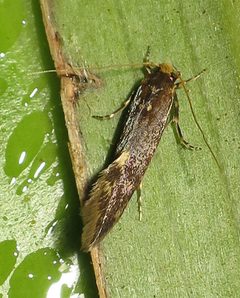
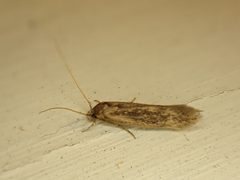
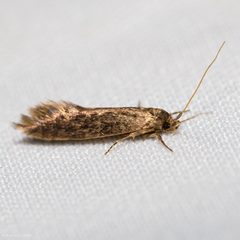
Opogona omoscopa is a small in the Tineidae with a wingspan of 18–22 mm. It has a broad native distribution spanning western Australia, New Zealand, southeast Asia, Africa, and islands of the Indian Ocean, and has been introduced to Europe, the United Kingdom, and the United States. The is attracted to ultraviolet light and has been documented at blacklighting events in California.
Pronunciation
How to pronounce Opogona omoscopa: //ˌoʊpəˈɡoʊnə ˌoʊməˈskoʊpə//
These audio files are automatically generated. While they are not always 100% accurate, they are a good starting point.
Identification
Images
Appearance
Wingspan approximately 18–22 mm. Detailed coloration and pattern descriptions are not provided in available sources.
Habitat
Associated with environments containing decaying vegetation, rotting wood, and compost. Larvae develop in decomposing plant material and have been recorded from cultivated settings including pineapple plantations and ornamental plantings.
Distribution
Native to western Australia, New Zealand, southeast Asia, Africa (Ethiopia to South Africa), and islands of the Indian Ocean including Île Amsterdam. Introduced and established in the United States (California documented), Europe, and the United Kingdom.
Seasonality
have been recorded at blacklighting events in California during July and August, suggesting summer activity in temperate introduced ranges. Seasonal patterns in native range are not documented.
Diet
Larvae feed on decaying vegetation including rotting wood, cork, compost, rhubarb, gladioli corms, and pineapple roots. Documented plants include Persea sp. (avocado), Limonium sp., Cyclamen sp., Thuja sp., Fuchsia sp., Saccharum sp. (sugarcane), and Quercus suber (cork oak).
Host Associations
- Persea sp. - larval Lauraceae
- Limonium sp. - larval Plumbaginaceae
- Cyclamen sp. - larval Myrsinaceae
- Thuja sp. - larval Cupressaceae
- Fuchsia sp. - larval Onagraceae
- Saccharum sp. - larval Poaceae, sugarcane
- Quercus suber - larval Fagaceae, cork oak
- Ananas comosus - larval pineapple roots, inferred from source
- Rheum rhabarbarum - larval rhubarb, inferred from source
- Gladiolus - larval corms, inferred from source
Life Cycle
Complete with , larval, pupal, and stages. Larvae develop in decaying plant material and can damage living plants by feeding on roots and corms. Specific duration of developmental stages is not documented.
Behavior
are and attracted to ultraviolet light. Documented at blacklighting displays in California from approximately 9:15 to 11:00 p.m.
Ecological Role
Decomposer; larvae process decaying plant material. In agricultural and horticultural settings, can become a pest by damaging living plant roots and corms.
Human Relevance
Considered a pest of cultivated plants including strawberries, bird of paradise, and pineapple. The 'Opogona crown borer' refers to larval damage to plant crowns. Subject of entomological study and public education events such as Night at the Bohart Museum of Entomology.
Similar Taxa
- Other TineidaeSimilar small size and association with decaying organic matter; identification to requires detailed examination not described in available sources.
More Details
Collection records
Recorded at blacklighting events in Davis, California in 2019 and 2022, among 11+ documented during Night events at the Bohart Museum of Entomology.
Taxonomic history
Originally described as Hieroxestis omoscopa by Meyrick in 1893, later transferred to Opogona.
Sources and further reading
- BugGuide
- Wikipedia
- GBIF taxonomy match
- iNaturalist taxon
- NCBI Taxonomy
- Catalogue of Life
- Blacklighting at the Bohart: They Saw the Light | Bug Squad
- What Will You See at Bohart Museum Open House | Bug Squad
- Oh, What a (Moth) Night! | Bug Squad
- Mark Your Calendar for 'Moth Night' at Bohart Museum: July 30 | Bug Squad
- A Night at the Bohart Museum: Moth Night on Saturday, July 22 | Bug Squad