
Dioryctria merkeli
Mutuura & Munroe, 1979
loblolly pine coneworm moth
Dioryctria merkeli is a snout moth in the Pyralidae, described in 1979 from the eastern United States. The larvae are known to feed on Pinus species, boring into the cambium of trunks, branches, and twigs. This species is part of a whose members are commonly known as coneworm moths due to their larval habit of feeding in conifer cones and woody tissues.
Pronunciation
How to pronounce Dioryctria merkeli: //ˌdaɪ.ɔːrˈɪk.tri.ə ˈmɜr.kɛ.li//
These audio files are automatically generated. While they are not always 100% accurate, they are a good starting point.
Identification
Dioryctria are challenging to distinguish without examination of genitalia or molecular analysis. D. merkeli can likely be separated from other eastern North American Dioryctria by a combination of geographic distribution (southeastern U.S. coastal plain association), plant specificity to Pinus species, and subtle differences in wing pattern and genitalia structure. Accurate identification typically requires reference to the original description or determination.
Images
Appearance
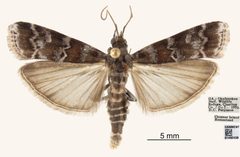
are small to medium-sized typical of the Pyralidae, with wingspan likely in the range of 15-25 mm based on . As with other Dioryctria , adults have narrow, somewhat elongated forewings and a characteristic resting posture with wings folded tent-like over the body. Coloration and specific pattern details are not documented in available sources. Larvae are wood-boring caterpillars with typical lepidopteran larval adapted for tunneling in woody tissue.
Habitat
Associated with pine forests and woodlands where Pinus occur. Larval is within the woody tissues of living pine trees, specifically the cambium layer of trunks, branches, and twigs.
Distribution
Eastern United States, specifically recorded from Maryland, Texas, Mississippi, Georgia, and Florida. The distribution appears centered on the southeastern coastal plain and adjacent regions where loblolly pine and related Pinus are native.
Diet
Larvae feed on Pinus (pines), boring into the cambium of the trunk, branches, and twigs. The specific mechanism of selection and whether larvae feed preferentially on particular Pinus species within its range is not documented.
Host Associations
- Pinus - larval -level association; specific pine not documented
Life Cycle
Complete with , larval, pupal, and stages. Larvae are wood-borers in living pine tissue. likely occurs within the larval tunnel or in a constructed chamber. Detailed timing of life stages and number of per year are not documented.
Behavior
Larvae exhibit wood-boring , tunneling into the cambium layer of pine woody tissues. This feeding habit is characteristic of coneworm moths and can cause damage to trees. behavior including activity, mating, and oviposition patterns has not been specifically documented.
Ecological Role
As a primary consumer, larvae transfer energy from pine trees to higher . Wood-boring activity may contribute to tree stress or mortality, particularly in stressed or young trees. The likely serves as prey for various including birds, , and other natural enemies, though specific ecological interactions are not documented.
Human Relevance
Potential forest pest due to larval boring damage in pine trees. The extent of economic impact relative to other Dioryctria is not quantified in available sources.
Similar Taxa
- Dioryctria amatellaSouthern pine coneworm, overlaps in southeastern U.S. distribution and pine association; distinguished by specific host preferences and subtle morphological differences
- Dioryctria clarioralisAnother eastern North American coneworm with overlapping range; requires genitalia examination for reliable separation
- Dioryctria zimmermaniPine cone with similar ; distinguished by larval feeding habits and geographic distribution patterns
More Details
Taxonomic history
Described by Akira Mutuura and Eugene G. Munroe in 1979, based on specimens from the eastern United States. The specific epithet 'merkeli' presumably honors an individual, though the etymology is not explicitly stated in available sources.
Research needs
Significant gaps exist in knowledge of this , including: and coloration, precise range within Pinus, geographic distribution limits, seasonality and voltinism, and economic impact as a forest pest. Fresh specimens and field observations would contribute substantially to understanding this poorly documented species.