
Dioryctria zimmermani
Grote, 1877
Zimmerman pine moth
Dioryctria zimmermani, the Zimmerman pine , is a conifer-feeding moth in the Pyralidae. It is a significant pest of pine trees in the midwestern and northeastern United States and southern Canada. The has one per year, with emerging in late August and hatching through mid-September. Larvae bore into pine bark and cones, causing damage to trees.
Pronunciation
How to pronounce Dioryctria zimmermani: //ˌdaɪ.əˈrɪk.tri.ə ˈzɪm.ɚˌmæn.aɪ//
These audio files are automatically generated. While they are not always 100% accurate, they are a good starting point.
Identification
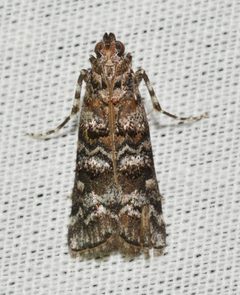
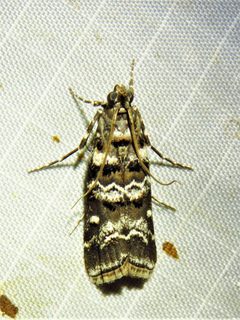
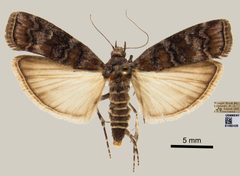
The zigzag pattern on the gray and red-brown forewings, combined with pale yellowish hindwings, distinguishes from many similar . Larvae may be distinguished from other Dioryctria by association and geographic range, though species-level identification within the D. zimmermani species group is notoriously difficult due to overlapping morphological, molecular, and behavioral traits. Molecular analysis may be required for definitive identification.
Images
Appearance
have a wingspan of approximately 37 mm. Forewings are mottled gray and red-brown with zigzag light and dark markings. Hindwings are yellowish white. Full-grown larvae are 18–25 mm long.
Habitat
Pine forests and plantations; larvae occur in bark recesses and cones of trees. In Michigan studies, were laid almost entirely on the main stem of host trees.
Distribution
Southern Canada (Alberta, Manitoba, Saskatchewan), northeastern and Great Lakes areas of the United States, with a disjunct in eastern Nebraska.
Seasonality
emerge during the last three weeks of August. hatch through mid-September. Larvae overwinter in and are active in spring and early summer.
Diet
Larvae feed on various Pinus , with preference for Austrian pine (Pinus nigra) and Scots pine (Pinus sylvestris).
Host Associations
- Pinus - larval food plantVarious pine ; preference for Austrian and Scots pine
Life Cycle
One per year. emerge late August. laid on main stem of trees hatch through mid-September. Newly hatched larvae enter bark recesses and spin without feeding initially. Six larval stadia are tentatively proposed based on capsule measurements. Larvae and pupae show fairly uniform vertical distribution over the main stem in spring and early summer, with concentration in middle by late summer.
Behavior
Larvae spin silk in bark recesses immediately after hatching, entering a period of inactivity before resuming development. Vertical distribution of larvae shifts seasonally: uniform over the main stem in spring and early summer, becoming concentrated in middle by late summer.
Ecological Role
Herbivore and pest of native and ornamental pine trees. Subject to by and other natural enemies. Co-occurs with related coneworm such as Dioryctria abietivorella in some areas. Serves as for parasitoid including species in the Baryscapus.
Human Relevance
Considered a serious pest of pine in the midwestern United States. Larval boring damage affects both native forests and ornamental plantings. Management is complicated by concealed larval habit within bark and cones.
Similar Taxa
- Dioryctria abietivorellaCo-occurs in same geographic areas and shares similar conifer-feeding habits; requires careful examination for separation
- Other Dioryctria zimmermani species group members boundaries within this group are problematic due to overlapping molecular, morphological, and behavioral traits; molecular analysis often required for definitive identification
More Details
Taxonomic complexity
The Dioryctria zimmermani group exhibits incongruence between established species limits and molecular diversity, making identification and delimitation difficult. Gene tree-species tree discordance may result from incomplete lineage sorting or .
Biological control potential
Related Dioryctria in Asia are targets for research using such as Baryscapus dioryctriae, which may inform management approaches for North American coneworm pests.
Sources and further reading
- BugGuide
- Wikipedia
- GBIF taxonomy match
- iNaturalist taxon
- NCBI Taxonomy
- Catalogue of Life
- Baryscapus dioryctriae Archives - Entomology Today
- Bug Eric: Wasp Wednesday: Blue Mud Dauber, Chalybion californicum
- Bug Eric: New Mexico Night Bugs
- Bug Eric: My Personal National Moth Week, 2017
- Bug Eric: September 2017
- New Wasp Species Discovered Parasitizing Pests of Pine Trees
- BIOLOGY AND BEHAVIOR OF ZIMMERMAN PINE MOTH, DIORYCTRIA ZIMMERMANI, IN MICHIGAN
- Complexity inDioryctria zimmermaniSpecies Group: Incongruence between Species Limits and Molecular Diversity