
Acrobasis suavella
(Zincken, 1818)
Thicket Knot-horn, Blackthorn Knot-horn
Acrobasis suavella is a small pyralid native to Europe, with an established introduced in southwestern Canada. fly nocturnally during summer months and are readily attracted to light. The larva is a concealed feeder, constructing a silken gallery within which it feeds on plant material over an extended autumn-to-spring period. The has been the subject of sequencing as part of the Darwin Tree of Life Project.
Pronunciation
How to pronounce Acrobasis suavella: //æ.krəˈbeɪ.sɪs swɑːˈvɛl.lə//
These audio files are automatically generated. While they are not always 100% accurate, they are a good starting point.
Identification
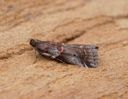
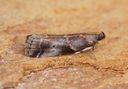
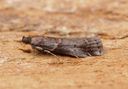
The combination of moderate size (22–24 mm wingspan), ruddy purple-grey forewing coloration, and summer period helps distinguish from similar small pyralids. The larval stage is identified by its distinctive silken gallery constructed among plant branches, coated with debris and . Distinguished from congeneric by host association (primarily Prunus spinosa) and gallery structure; precise identification of larvae may require molecular methods or rearing to adult.
Images
Habitat
Associated with stunted and isolated Prunus spinosa (blackthorn) plants in open , including downland and grassland. In Britain, most widespread across southern England and Wales where such plant conditions occur. The favors open, sunny situations rather than dense woodland.
Distribution
Native to Europe, ranging across the continent east to the Caucasus. In Britain and Ireland, most widespread in southern England and Wales, with scattered records elsewhere including a possible vagrant from Shetland. Accidentally introduced and established in North America around Vancouver, British Columbia since at least the early 20th century.
Seasonality
on wing from June to August in Britain and Ireland, with low numbers extending to October in Belgium. Single per year (). Larva feeds from September through June, within its silken gallery.
Diet
Larva feeds internally on plant material, primarily within branches of Prunus spinosa (blackthorn). Recorded alternative include Cotoneaster, Crataegus, and Sorbus.
Host Associations
- Prunus spinosa - primary Preferred ; larva feeds within branches of stunted, isolated plants
- Cotoneaster - secondary Documented larval feeding record
- Crataegus - secondary Documented larval feeding record
- Sorbus - secondary Documented larval feeding record
Life Cycle
. stage not well documented in sources. Larva feeds from September to June within a thick silken tube coated with leaf fragments and , in this protected structure. occurs within or immediately adjacent to the larval gallery. in summer, with period June–August (extending to October in some regions).
Behavior
are strictly and seldom observed by day. Strongly attracted to light, making them readily detectable by light trapping. Larva constructs and occupies a protective silken gallery throughout its feeding period, a concealed feeding strategy that reduces exposure to and .
Ecological Role
Herbivore specializing on Rosaceae, particularly Prunus. The larval gallery construction represents a case-building that creates a microhabitat potentially utilized by other organisms. Serves as for , including ichneumonids in the Mesostenus.
Human Relevance
No documented economic significance. Possible minor damage to ornamental Prunus, Cotoneaster, or Crataegus in gardens, but not considered a pest. sequenced as part of the Darwin Tree of Life Project, contributing to biodiversity research. North American establishment around Vancouver likely resulted from accidental introduction via ornamental plants trade.
Similar Taxa
- Acrobasis nuxvorellaPecan nut casebearer; larger economic pest of pecan in North America, distinguished by specificity (Carya illinoinensis) and geographic range (not overlapping with A. suavella in native range)
- Other Acrobasis speciesNumerous congeneric share concealed larval feeding habits; precise identification requires examination of genitalia, larval gallery characteristics, or molecular methods
More Details
Genome sequencing
sequenced as part of the Darwin Tree of Life Project from a male specimen collected at Wytham Woods, Oxfordshire, UK. Assembly size 647.3 Mb with 30 chromosomal pseudomolecules (29 + Z ) and 15.31 kb mitochondrial genome, containing 19,101 protein-coding genes.
North American establishment
Established in the Vancouver, British Columbia region since at least the early 20th century, representing one of the earlier documented European introductions to western North America. Mechanism of introduction unknown but likely via imported plants.
Sources and further reading
- BugGuide
- Wikipedia
- GBIF taxonomy match
- iNaturalist taxon
- NCBI Taxonomy
- Acrobasis nuxvorell Archives - Entomology Today
- Pecan Nut Casebearer: New Guide Provides IPM Options
- Bug Eric: Wasp Wednesday: Mesostenus
- Bug Eric: A Potential New Host Record for Calliephialtes grapholithae (Hymenoptera: Ichneumonidae) from a Paper Wasp nest (Hymenoptera: Vespidae: Polistes metricus)
- The genome sequence of the Thicket Knot-horn, Acrobasis suavella (Zincken, 1818).