
Acrobasis caliginella
Hulst, 1878
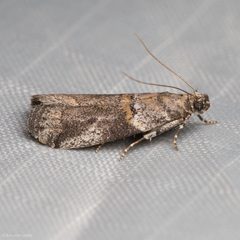
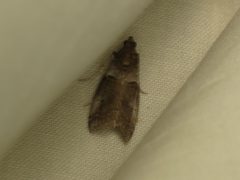
Acrobasis caliginella is a snout moth (Pyralidae: Phycitinae) described by George Duryea Hulst in 1878. The is restricted to the southwestern United States, with confirmed records from California and Arizona. Larvae feed on multiple oak species (Quercus spp.), including coast live oak and interior live oak. Like other Acrobasis species, it likely develops as a concealed feeder in plant tissues.
Pronunciation
How to pronounce Acrobasis caliginella: /ˌæ.krəˈbeɪ.sɪs kæ.lɪ.dʒɪnˈɛl.ə/
These audio files are automatically generated. While they are not always 100% accurate, they are a good starting point.
Identification
Acrobasis are small to medium pyralid moths with distinctive elongated labial palps forming a "snout." Specific diagnostic features for A. caliginella are not well documented in available sources. Identification to species level likely requires examination of genitalia or reference to original description. The species may be distinguished from other Acrobasis in its range by association with California oak species and geographic restriction to California and Arizona.
Images
Habitat
Associated with oak woodlands and forests where Quercus occur. include coastal scrub, chaparral, and montane oak in California and Arizona.
Distribution
United States: California and Arizona.
Diet
Larvae feed on Quercus agrifolia (coast live oak), Quercus wislizeni (interior live oak), Quercus dumosa, Quercus durata (leather oak), and Quercus vaccinifolia (huckleberry oak).
Host Associations
- Quercus agrifolia - larval food plantcoast live oak
- Quercus wislizeni - larval food plantinterior live oak
- Quercus dumosa - larval food plant
- Quercus durata - larval food plantleather oak
- Quercus vaccinifolia - larval food planthuckleberry oak
Ecological Role
As a herbivore on native California oaks, larvae contribute to nutrient cycling in oak woodland . The serves as a for , including ichneumonids in the Mesostenus, which have been documented parasitizing other Acrobasis species.
Similar Taxa
- Acrobasis nuxvorellaPecan nut casebearer is a major agricultural pest on pecan (Carya illinoinensis) in the southern and central United States, but does not occur in California and Arizona where A. caliginella is found. A. nuxvorella has different associations and economic significance.
- Other Acrobasis speciesNumerous congeneric exist in North America, many with specific plant associations. Accurate identification requires examination of morphological details or genitalia, as external features are often similar among species.
More Details
Parasitoid associations
The Acrobasis serves as for in the Ichneumonidae. Mesostenus , including M. gracilis, have been documented parasitizing Acrobasis caterpillars. The related species Acrobasis betulella, A. juglandis, and A. rubrifasciella are recorded hosts for the ichneumonid Calliephialtes grapholithae, suggesting potential similar parasitoid relationships for A. caliginella.
Taxonomic history
Described by George Duryea Hulst in 1878, a prominent American entomologist who described numerous Lepidoptera in the late 19th century. The specific epithet 'caliginella' derives from Latin 'caligo' meaning darkness or mist, possibly referring to coloration or .
Sources and further reading
- BugGuide
- Wikipedia
- GBIF taxonomy match
- iNaturalist taxon
- Acrobasis nuxvorell Archives - Entomology Today
- Pecan Nut Casebearer: New Guide Provides IPM Options
- Bug Eric: Wasp Wednesday: Mesostenus
- Bug Eric: A Potential New Host Record for Calliephialtes grapholithae (Hymenoptera: Ichneumonidae) from a Paper Wasp nest (Hymenoptera: Vespidae: Polistes metricus)