
Pococera asperatella
Clemens, 1860
Maple Webworm Moth
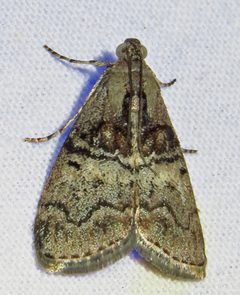
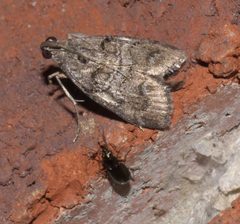
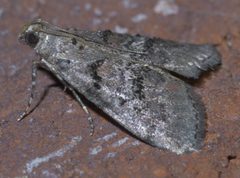
Pococera asperatella, commonly known as the maple webworm , is a pyralid moth native to North America. are characterized by their powdery gray coloration. The has one per year. Larvae feed on foliage of hardwood trees, particularly maple (Acer) and sumac (Rhus) species. The caterpillars are known prey of the four-toothed mason wasp (Monobia quadridens), which paralyzes them to provision its nest .
Pronunciation
How to pronounce Pococera asperatella: /poʊˈkoʊsərə əˌspɛrəˈtɛlə/
These audio files are automatically generated. While they are not always 100% accurate, they are a good starting point.
Identification
The powdery gray coloration of distinguishes them from more vividly patterned pyralid moths. Definitive identification likely requires examination of genitalia or reference to regional guides. The is associated with maple and sumac , which may aid in field recognition.
Images
Habitat
Associated with hardwood forests and woodlands containing maple (Acer) and sumac (Rhus) . Larvae inhabit the foliage of trees.
Distribution
North America, with records from: United States (Alabama, Illinois, Massachusetts, Minnesota, New Hampshire, New Jersey, North Carolina, Oklahoma, Pennsylvania, South Carolina, Tennessee, Texas, Virginia, Wisconsin, Vermont) and Canada (Ontario, Alberta, Manitoba, Saskatchewan).
Seasonality
One per year. active during the growing season; specific period not documented in available sources but presumably summer to early fall based on single-generation .
Diet
Larvae feed on foliage of various hardwood , specifically documented on Acer (maple) and Rhus (sumac) species. feeding habits are not documented.
Host Associations
- Acer - larval foliage
- Rhus - larval foliage
Life Cycle
One per year. and pupal stages are not documented in available sources. Larval development occurs on plant foliage.
Behavior
Larval includes feeding on foliage; specific nesting or web-spinning behaviors implied by but not explicitly documented. are presumably or like most pyralid moths.
Ecological Role
Herbivore as larva, consuming hardwood tree foliage. Serves as prey for predatory , specifically documented as prey of Monobia quadridens (four-toothed mason wasp).
Human Relevance
Minor potential as a defoliator of ornamental maples and sumacs. Documented as prey of beneficial predatory that may help control caterpillar .
Similar Taxa
- Pococera robustellaPine webworm moth in same ; feeds on Pinus rather than hardwoods, allowing ecological separation
- Other EpipaschiinaeMany pyralid moths share similar gray coloration; plant association and geographic range help distinguish P. asperatella
More Details
Predator documentation
The is explicitly documented as prey of Monobia quadridens, a solitary mason wasp that hunts small caterpillars including leafrollers and webworms. This -prey relationship was recorded by Byers (1972) and discussed in detail by entomologist Eric Eaton.
Taxonomic history
Originally described as Lanthaphe asperatella by Clemens in 1860 before transfer to Pococera.