
Desmia desmialis
Barnes & McDunnough, 1914
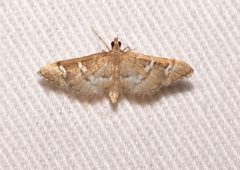
Desmia desmialis is a small crambid described from Arizona in 1914. The is recognized by its distinctive wing pattern featuring multiple white patches on brown forewings and semiparallel dark lines on the hindwings. It belongs to a containing several similar North American species, including the .
Pronunciation
How to pronounce Desmia desmialis: //ˈdɛz.mi.ə dɛzˈmɪə.lɪs//
These audio files are automatically generated. While they are not always 100% accurate, they are a good starting point.
Identification
The combination of three white patches on forewings—particularly the subterminal oval patch connected to by dark streak—distinguishes this from . The two semiparallel dark lines on hindwings with whitish intervening space is also diagnostic. Separable from () by specific arrangement and shape of white patches; D. funeralis has more extensive white markings with different pattern geometry.
Images
Appearance
Small with wingspan 17–20 mm. Forewings brown over whitish ground color with three prominent white patches: a quadrate patch near end of bordered by black lines laterally, a second similar patch below it, and a third irregular oval patch in subterminal area outlined in black and connected to by dark streak. Hindwings brown with two semiparallel waved dark lines crossing area; space between lines whitish with brown .
Distribution
Known only from Arizona, USA. Recorded locations appear limited based on available specimen records and observations.
Behavior
; attracted to blacklighting. presumably active during summer months based on related .
Similar Taxa
- Desmia funeralisSimilar size and color pattern, but D. funeralis has more extensive white forewing markings with different geometric arrangement; both attracted to lights and may co-occur in some areas
More Details
Taxonomic history
Described by William Barnes and James Halliday McDunnough in 1914, two prominent North American lepidopterists of the early 20th century. The specific epithet 'desmialis' appears to be derived from the name, forming a tautonym-like construction.