
Desmia funeralis
Hübner
grape leaffolder, grape leaf-folder
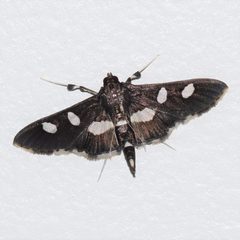
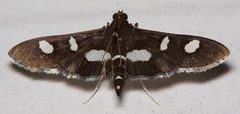
, commonly known as the , is a in the Crambidae. It is a minor pest of grape vineyards across the United States, with larvae that feed on grape leaves, causing characteristic leaf folding or rolling damage. The is widely distributed from the southern United States through California, extending north to the northeastern states and southeastern Canada. Severe have occurred in localized areas, particularly when natural fail to control moth numbers.
Pronunciation
How to pronounce Desmia funeralis: //ˈdɛs.mi.ə fjuː.nəˈrɑː.lɪs//
These audio files are automatically generated. While they are not always 100% accurate, they are a good starting point.
Identification
The can be distinguished from similar Crambidae by its association with grape plants and the distinctive leaf-folding of its larvae. moths are attracted to blacklighting displays and have been noted as among the most striking observed at moth night events. Specific adult morphological features distinguishing it from congeneric species are not detailed in available sources.
Images
Habitat
Vineyards and agricultural areas associated with grape . The is strongly tied to containing grape plants (Vitis spp.), which serve as the larval .
Distribution
Widely distributed across the southern United States to California, north to the northeastern states and southeastern Canada. Specific records exist from Alberta, Manitoba, and Saskatchewan in Canada, and Vermont in the United States.
Diet
Larvae feed exclusively on grape leaves (Vitis spp.), causing defoliation through leaf folding and rolling .
Host Associations
- grape - larval plantVitis spp.; larvae feed on leaves causing characteristic folding damage
Behavior
Larvae exhibit leaf-folding or leaf-rolling while feeding on grape foliage. In Florida, damage is concentrated in September and October when vineyard spray programs are discontinued post-harvest. in California have been associated with failures of .
Ecological Role
Minor agricultural pest of grape crops. are significantly influenced by , which normally provide . Excessive larval defoliation can deplete food reserves in grape vines, potentially reducing the size of subsequent crops.
Human Relevance
Economic pest in grape vineyards, particularly problematic when practices are interrupted or when natural enemy are disrupted. Damage is most severe in late season when applications cease.
Similar Taxa
- Desmia maculalisCongeneric potentially overlapping in range and ; specific distinguishing features not documented in available sources
More Details
Predation by mason wasps
caterpillars are documented prey of the four-toothed mason wasp (Monobia quadridens), a solitary that provisions its nests with paralyzed caterpillars. This represents a significant natural source of mortality for leaffolder larvae.
Taxonomic note
The iNaturalist database lists this as a 'complex,' suggesting potential cryptic diversity or unresolved boundaries within the group.
Sources and further reading
- BugGuide
- GBIF taxonomy match
- iNaturalist taxon
- NCBI Taxonomy
- Catalogue of Life
- Celebrating National Moth Night at the Bohart Museum of Entomology | Bug Squad
- Ready for Moth Night at UC Davis? | Bug Squad
- Bohart Museum Open House: Let's Celebrate Moths! | Bug Squad
- Bug Eric: Wasp Wednesday: Four-toothed Mason Wasp
- Bug Eric: Spring (Butterfly) Beauties
- Grape Leaffolder, Desmia funeralis (Hübner) (Insecta: Lepidoptera: Crambidae)
- Parasitoids and Predators of Desmia funeralis Hübner 17961 in Grape Vineyards at Parras, Coahuila, Mexico