
Desmia
Westwood, 1832
Species Guides
8- Desmia deploralis(deploring desmia moth)
- Desmia desmialis
- Desmia funeralis(grape leaffolder)
- Desmia maculalis(Grape Leafroller Moth)
- Desmia ploralis(mournful desmia moth)
- Desmia subdivisalis
- Desmia tages
- Desmia ufeus
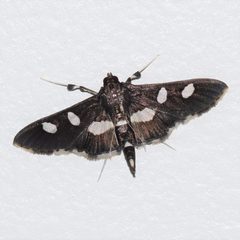
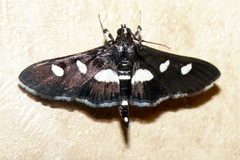
Desmia is a of in the Crambidae, erected by John O. Westwood in 1832. The genus contains small to medium-sized moths, most commonly brown with variable white spotting on the wings, though some exhibit orange or blue-green coloration. The majority of species are distributed in South and Central America, with additional species present in Africa, Asia, and North America. Several species are of agricultural significance, particularly Desmia funeralis, the grape leaffolder, which is a documented pest of grapevines in the United States and Mexico.
Pronunciation
How to pronounce Desmia: /ˈdɛs.mi.a/
These audio files are automatically generated. While they are not always 100% accurate, they are a good starting point.
Identification
North American are visually similar and often require dissection or analysis for definitive identification. The is distinguished from similar crambid genera by the upward-curved abdominal tip. The combination of small size, brown ground color with white spotting, and curved separates most Desmia from superficially similar pyraloid moths. Species-level identification within the genus is challenging and may require examination of genitalia or molecular data.
Images
Appearance
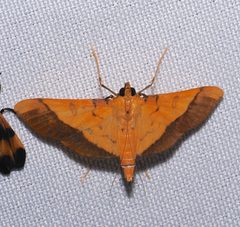
Small to medium-sized with highly variable wing patterns. Most are brown with variable white spots on the wings. Some species, such as Desmia flavalis, are orange without white markings. Others, like Desmia filicornis, display a blue-green sheen. The terminates in a characteristically curved, upward-pointing tip. Wing patterns are generally subdued with geometric spotting rather than bold bands.
Habitat
Found in diverse including vineyards, agricultural areas, and natural vegetation. Larvae are associated with plants including grapevines (Vitis spp.) and wild coffee in the southern New World. are and attracted to light.
Distribution
Predominantly Neotropical, with the majority of in South and Central America. Also present in Africa, Asia, and North America. Documented in the United States (California, Florida, and eastern regions), Mexico (Coahuila), and widely across the Neotropics.
Seasonality
are active during warmer months. In Florida, larval damage peaks in September and October. Activity patterns vary by region and .
Diet
Larvae are leaf-feeders, primarily on grapevines (Vitis spp.) and related plants. Some southern New World feed on wild coffee. Specific feeding habits are not documented in available sources.
Host Associations
- Vitis spp. - larval plantgrapevines; primary for pest including Desmia funeralis
- wild coffee - larval plantdocumented for southern New World
Life Cycle
Larvae are small leafroller caterpillars that feed on plant foliage. occurs within silked leaf rolls or other sheltered locations. emerge and are . Specific details on placement, larval instars, and pupal duration are not documented in available sources.
Behavior
Larvae construct leaf rolls or folds while feeding, giving the 'leaffolder' to pest . are attracted to light and have been documented at blacklighting events. activity pattern.
Ecological Role
Herbivores as larvae, with some functioning as minor agricultural pests. Subject to and pressure, with associated with failures of natural enemy control. Contributes to dynamics in vineyard and natural .
Human Relevance
Desmia funeralis, the grape leaffolder, is a documented agricultural pest of grapevines in the United States and Mexico. in California have been associated with failures. In Florida, post-harvest damage occurs when spray programs are discontinued. Excessive defoliation can deplete vine food reserves and reduce subsequent crop yields. The is also of interest to lepidopterists and is featured in public education events.
Similar Taxa
- Other Crambidae genera in SpilomelinaeSimilar small size and wing shape; Desmia distinguished by upward-curved abdominal tip and specific wing pattern elements
- Desmia species within the genusNorth American are visually similar and often require genitalia examination or analysis for separation; external frequently insufficient
More Details
Taxonomic history
erected by John O. Westwood in 1832. Formerly included now transferred to other genera, such as Desmia horaria (now Desmia incomposita). Status of Desmia sextalis is currently unknown.
Research challenges
-level within Desmia remains problematic, particularly in North America where cryptic species or morphologically similar require molecular or anatomical study for reliable identification.
Sources and further reading
- BugGuide
- Wikipedia
- iNaturalist taxon
- NCBI Taxonomy
- Catalogue of Life
- Celebrating National Moth Night at the Bohart Museum of Entomology | Bug Squad
- Ready for Moth Night at UC Davis? | Bug Squad
- Bug Eric: Wasp Wednesday: Four-toothed Mason Wasp
- Grape Leaffolder, Desmia funeralis (Hübner) (Insecta: Lepidoptera: Crambidae)
- Parasitoids and Predators of Desmia funeralis Hübner 17961 in Grape Vineyards at Parras, Coahuila, Mexico