
Uresiphita
Hübner, 1825
Species Guides
1- Uresiphita reversalis(Genista Broom Moth)
Uresiphita is a of crambid comprising approximately six recognized distributed across North America, New Zealand, Europe, and the Middle East. The genus is notable for larval of quinolizidine alkaloids from leguminous plants, a chemical defense mechanism against . Several species have expanded their ranges through association with introduced host plants.
Pronunciation
How to pronounce Uresiphita: //jʊˌrɛsɪˈfaɪtə//
These audio files are automatically generated. While they are not always 100% accurate, they are a good starting point.
Identification
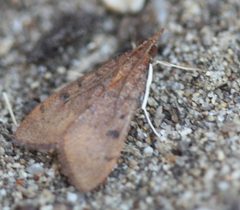
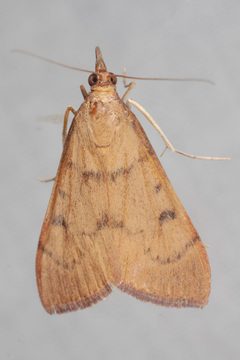
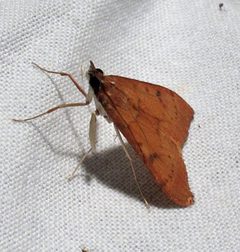
of Uresiphita are small to medium-sized with wingspans typically 20-35 mm. Uresiphita reversalis has a distinctive white body and legs, with bright yellow or orange hindwings usually concealed at rest. Larvae are aposematically colored, often with bold patterns suggesting chemical defense.
Images
Habitat
include urban and suburban areas, gardens, and natural vegetation supporting leguminous plants. In New Zealand, U. polygonalis maorialis occurs on kōwhai trees (Sophora spp.) in both urban and natural settings. U. reversalis inhabits arid and semi-arid regions in southwestern North America, expanding into coastal and interior California.
Distribution
North America (southwestern United States, Mexico, expanding to California, Great Lakes, and Atlantic coast); New Zealand (native); Europe (Denmark, Norway, Sweden recorded); Israel (U. limbalis).
Seasonality
Uresiphita reversalis: multiple annually in southern regions ( as short as 5 weeks in summer), fewer in northern areas; typically as pupae. In Berkeley, California, two periods occur: March-May and July-October. U. polygonalis maorialis in Canterbury, New Zealand: with flight from late November to late February, peaking in late December.
Diet
Larvae feed primarily on legumes (Fabaceae). U. reversalis: native include Sophora, Lupinus, Baptisia; expanded to introduced Genista (French broom, G. monspessulana), plus Acacia, false indigo (Baptisia), and occasionally Crapemyrtle and honeysuckle. U. polygonalis maorialis: Sophora spp. (kōwhai), Lupinus arboreus.
Host Associations
- Sophora secundiflora - native Texas Mountain Laurel; primary native for U. reversalis in southwestern North America
- Genista monspessulana - introduced French broom; U. reversalis has expanded range to exploit this plant
- Sophora microphylla - native kōwhai; preferred for U. polygonalis maorialis in New Zealand
- Sophora tetraptera - native preferred for oviposition and feeding by U. polygonalis maorialis in Wellington
- Lupinus arboreus - native tree lupine; for U. polygonalis maorialis
- Lupinus - native -level association for U. reversalis
- Baptisia - native false indigo; for U. reversalis
- Acacia - for U. reversalis
Life Cycle
U. reversalis: laid in clusters averaging ~19 per clutch on leaf surfaces; five larval instars; in opaque white cocoon amid dense webbing; duration highly variable (5-25 weeks) depending on season and latitude; 4-5 annually possible in favorable conditions. U. polygonalis maorialis: in Canterbury, New Zealand.
Behavior
Larvae of U. reversalis feed gregariously in exposed daytime groups, contrary to the solitary habit of most caterpillars. They construct dense silken webbing on plants. are and easily startled from resting positions. Larvae sequester host plant alkaloids for chemical defense.
Ecological Role
Herbivore and defoliator of leguminous plants; U. polygonalis maorialis is the main defoliator of Sophora spp. in New Zealand. Larvae serve as for including Meteorus pulchricornis (Braconidae) and Pimpla/Coccygomimus sanguinipes (Ichneumonidae). U. reversalis has been considered for of broom (Genista).
Human Relevance
U. reversalis: potential biocontrol agent for broom plants; caterpillars known as "Sophora Worm" or "Genista Broom ." U. polygonalis maorialis: cultural significance in Māori tradition associated with kōwhai trees; not considered a significant agricultural pest. of U. polygonalis maorialis identified for monitoring purposes.
Similar Taxa
- Pyralidae (sensu lato)Uresiphita was formerly classified in Pyralidae; some resources still list it there incorrectly. Currently placed in Crambidae, Pyraustinae.
- Other Crambidae generaUresiphita larvae are distinguished by aposematic coloration and alkaloid ; by white body/legs with contrasting hindwing colors.
Sources and further reading
- BugGuide
- Wikipedia
- GBIF taxonomy match
- iNaturalist taxon
- NCBI Taxonomy
- Catalogue of Life
- Bug Eric: Moth Monday: Sophora Worm
- Bug Eric: Wasp Wednesday: Pimpla sanguinipes
- Host plant preferences of Uresiphita reversalis (Guenée) (Lep., Crambidae)
- On biology and ecology ofUresiphita limbalis(Lepidoptera: Pyralidae) in Israel
- Identification of Components of the Sex Pheromone of the kōwhai Moth, Uresiphita Polygonalis Maorialis, a New Zealand Native Crambid
- Uresiphita reversalis (Lepidoptera: Pyralidae): Carrier-Mediated Uptake and Sequestration of Quinolizidine Alkaloids Obtained from the Host Plant Teline monspessulana
- Habitat Structure, Resources and Natural Enemies: Their Influence on Population Fluctuations of the Kowhai Moth Uresiphita Polygonalis Maorialis (Felder)
- Observations on the biology and distribution of Uresiphita reversalis (Lepidoptera, Crambidae), a defoliator of the native tree Calia secundiflora in México
- Observations on the emergence rates of Meteorus pulchricornis (Hymenoptera: Braconidae) and densities of Uresiphita polygonalis maorialis (Lepidoptera: Crambidae) larvae