
Uresiphita reversalis
(Guenée, 1854)
Genista Broom Moth, Sophora Worm
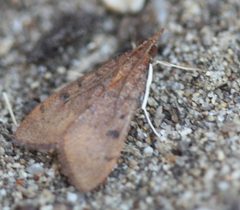
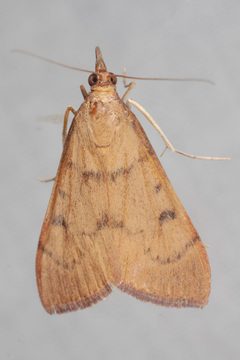
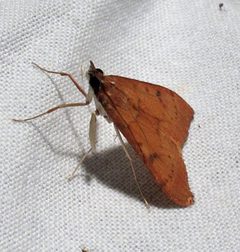
Uresiphita reversalis is a multivoltine crambid native to Mexico and the southwestern United States that has expanded its range north and east across North America. The caterpillars feed diurnally in groups on leguminous plants, particularly members of the tribe Genisteae, and sequester quinolizidine alkaloids for chemical defense. The has gained notoriety as both a pest of ornamental plants and a potential biocontrol agent for broom species. are small moths with distinctive white bodies and bright yellow or orange hindwings.
Pronunciation
How to pronounce Uresiphita reversalis: /ˌjʊrɪˈsɪfɪtə rɪˈvɜːrsəlɪs/
These audio files are automatically generated. While they are not always 100% accurate, they are a good starting point.
Identification
distinguished from similar crambid by combination of white body/legs and bright yellow or orange hindwings (usually hidden at rest). Formerly classified in Pyralidae, now placed in Crambidae; some sources still list outdated classification. Larvae identified by group-feeding on leguminous plants, silk webbing on branches, and aposematic coloration.
Images
Habitat
Secondary vegetation in arid and semiarid regions; open vegetation with evidence of disturbance such as intensive grazing. In Mexico, found in canyons and hills at elevations of 1885–2189 meters in association with Juniperus flaccida and Pinus cembroides. Urban and suburban environments where ornamental leguminous shrubs are planted.
Distribution
Native to Mexico and southwestern United States. Expanded range includes coastal California (established in Los Angeles by 1930, spreading through San Joaquin and Sacramento Valleys by 1980s), Bay Area, Great Lakes region, mid-Atlantic states, Maine, and Nova Scotia. Southernmost record in Hidalgo, Mexico. Also recorded from Cuba, Bermuda, Puerto Rico, and Jamaica.
Seasonality
Multivoltine with 4–5 annually in southern climates; fewer in northern areas. In Berkeley, California, two major periods: March–May and July–October. Larval abundance peaks April–May in some . typically occurs in pupal stage, though sometimes present in winter; larvae present throughout winter in some populations.
Diet
Larvae feed on leguminous plants (Fabaceae), particularly tribe Genisteae. Primary native include Sophora secundiflora (Texas Mountain Laurel), Lupinus , Baptisia (false indigo), and Acacia. Expanded host range includes introduced Genista species (French Broom, G. monspessulana; other broom plants), Cytisus species. do not feed.
Host Associations
- Sophora secundiflora - primary native Texas Mountain Laurel; common ornamental shrub
- Calia secundiflora - mescal bean; native tree in Mexico
- Genista monspessulana - introduced French broom; plant in California
- Cytisus species - introduced broom plants
- Lupinus species - native lupines
- Baptisia species - native false indigo
- Acacia species - acacia
- Teline monspessulana - studied for alkaloid
Life Cycle
Complete with variable timing depending on season and latitude. to can occur in 5 weeks under optimal summer conditions in southern areas, or up to 25 weeks in winter in northern areas. Eggs laid in clusters averaging ~19 per clutch on upper or underside of leaves; hatch in 5–6 days. Five larval instars: 1st–3rd instar approximately 16.5 days (reaching 15 mm); 4th–5th instar approximately 11 days (reaching 35 mm); total larval stage approximately one month. in opaque white silk cocoon amid dense webbing, away from plant; pupal stage approximately 20 days. Adult approximately 20 days; adults survive about 10 days; oviposition begins 3.5 days after emergence. Total development from egg to adult: approximately 56 days under laboratory conditions.
Behavior
Larvae feed diurnally in groups, in contrast to the solitary typical of most caterpillars. They produce extensive silk webbing covering defoliated branches, leaves, and pods. Larvae leave plant to pupate, constructing silk cocoons away from main plant. are and easily startled from resting places.
Ecological Role
Defoliator of native and ornamental leguminous plants. Sequesters plant quinolizidine alkaloids for chemical defense against . Potential biocontrol agent for Genista monspessulana in California. Preyed upon by damsel bugs and other piercing-sucking predators that bypass external chemical defenses. Parasitized by ichneumon wasps including Coccygomimus sanguinipes.
Human Relevance
Considered a pest of ornamental Sophora secundiflora (Texas Mountain Laurel) and other landscape legumes. Explored as biocontrol agent for broom (Genista, Cytisus). Formerly classified in Pyralidae, leading to potential confusion in older literature and some online resources.
Similar Taxa
- Uresiphita polygonalis maorialisCongeneric ; compared in biological studies
- Other Crambidae/Pyralidae mothsFormer Pyralidae classification leads to confusion; U. reversalis distinguished by associations and coloration
Misconceptions
Formerly classified in Pyralidae; still incorrectly placed there in some internet resources. Crapemyrtle (Lagerstroemia indica) and honeysuckle (Lonicera) sometimes listed as , but these associations are probably incidental rather than true host relationships.
Sources and further reading
- BugGuide
- GBIF taxonomy match
- iNaturalist taxon
- NCBI Taxonomy
- Catalogue of Life
- Bug Eric: Moth Monday: Sophora Worm
- Bug Eric: Wasp Wednesday: Pimpla sanguinipes
- Host plant preferences of Uresiphita reversalis (Guenée) (Lep., Crambidae)
- Uresiphita reversalis (Lepidoptera: Pyralidae): Carrier-Mediated Uptake and Sequestration of Quinolizidine Alkaloids Obtained from the Host Plant Teline monspessulana
- Observations on the biology and distribution of Uresiphita reversalis (Lepidoptera, Crambidae), a defoliator of the native tree Calia secundiflora in México
- Importance of quinolizidine alkaloids in the relationship between larvae ofUresiphita reversalis (Lepidoptera: Pyralidae) and a host plant,Genista monspessulana