
Eoreuma
Ely, 1910
Species Guides
3- Eoreuma callista
- Eoreuma densellus(Wainscot Grass-veneer)
- Eoreuma loftini(Mexican rice borer)
Eoreuma is a of in the Crambidae, first described by Ely in 1910. The genus contains 11 described , with Eoreuma loftini (Mexican rice borer) being the most economically significant. This species is a major agricultural pest of sugarcane, rice, sorghum, and corn in the southern United States and Mexico, causing substantial yield losses through larval tunneling in stalks. The genus is native to the Americas, with several species described from the southwestern United States and Mexico.
Pronunciation
How to pronounce Eoreuma: //iːoʊˈruːmə//
These audio files are automatically generated. While they are not always 100% accurate, they are a good starting point.
Identification
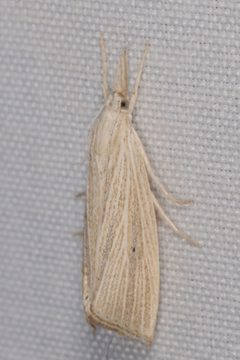
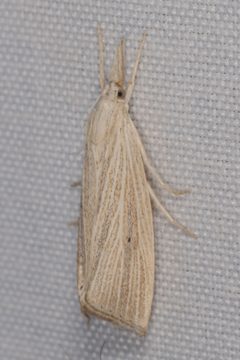
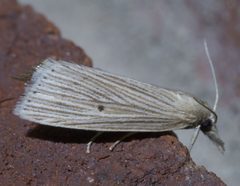
Eoreuma are small to medium-sized crambid . typically have white to buff-colored wings with subtle patterning. The Mexican rice borer (E. loftini) can be distinguished from similar stalk-boring crambids such as Diatraea saccharalis (sugarcane borer) by morphological features of the adult and larval stages; E. loftini larvae have conspicuous round brown or black spots on most body segments, while mature larvae show lighter or absent spots. Accurate species identification within the requires examination of genitalia and reference to original species descriptions.
Images
Distribution
The Eoreuma occurs in the Americas. Eoreuma loftini is native to Mexico and has expanded its range into the United States, first detected in southern Texas in 1980, then southwestern Louisiana in 2008, and central Florida in 2012. Other in the genus have been described from Arizona (E. arenella) and Texas (E. callista, E. confederata, E. crawfordi, E. evae).
Host Associations
- Poaceae (grasses) - plantEoreuma loftini feeds on sugarcane (Saccharum officinarum), rice (Oryza sativa), sorghum (Sorghum bicolor), corn (Zea mays), and non-crop grasses
- Lydella jalisco - Tachinid fly, solitary endoparasitoid of larval stages; first recorded in Nayarit, Mexico in 2022-2023 with 34.4% rate
- Allorhogas pyralophagus - Braconid imported for ; parasitized up to 65.6% of fifth- and sixth-instar larvae in field evaluations
- Alabagrus stigma - Braconid ; parasitized >5% of available E. loftini in field enclosures
- Goniozus natalensis - Bethylid ; parasitized >5% of available E. loftini
- Mallochia pyralidis - Ichneumonid , from Mexico
- Pediobius furvus - Eulophid ; searching studied in sugarcane
- Cotesia flavipes - Braconid ; development studied in E. loftini with evidence of developmental disruption
Behavior
Male Eoreuma loftini exhibit stereotyped courtship including wing fanning, curling, and attempted copulation when exposed to extracts from female ovipositors, indicating chemical communication mediates mate recognition. The response is dose-dependent and specific to extracts from sexually mature females.
Ecological Role
Eoreuma loftini functions as a significant agricultural pest in grass crop . Its larval tunneling activity damages plants and increases susceptibility to stalk rot and lodging. The serves as a host for multiple species, supporting local agent . Its range expansion in the United States provides a model for studying landscape-wide pest management across multiple crop systems.
Human Relevance
Eoreuma loftini (Mexican rice borer) is a major economic pest causing substantial yield losses in sugarcane, rice, and sorghum. Estimated potential losses exceed $40 million annually for rice and $200 million for sugarcane in Louisiana alone under worst-case scenarios. Management relies on (particularly chlorantraniliprole), early planting, varieties, and agents. traps are used for early detection. The is difficult to control with contact insecticides due to larval boring .
Similar Taxa
- Diatraea saccharalis (sugarcane borer)Similar stalk-boring crambid with overlapping range and distribution; E. loftini distinguished by larval spotting pattern and greater cold enabling northern range expansion
- Diatraea grandiosella (southwestern corn borer)Closely related stalk-boring crambid with similar and plants; E. loftini has faster time and different
- Elasmopalpus lignosellus (lesser cornstalk borer)Both are stalk-boring larvae in grass crops, but E. lignosellus feeds in silken tunnels covered with soil particles and has prominent transverse reddish-brown bands rather than round spots
Sources and further reading
- BugGuide
- Wikipedia
- GBIF taxonomy match
- iNaturalist taxon
- NCBI Taxonomy
- Catalogue of Life
- Stalk-boring insect pests - AgriLife Extension Entomology
- Insects that feed on developing grain in the head - AgriLife Extension Entomology
- Eoreuma-loftini - Entomology Today
- Eoreuma loftini Archives - Entomology Today
- Small Farms: On the Front Lines of Emerging Agricultural Pests
- A New Resource for Fighting the Mexican Rice Borer
- Behavioral Responses of Male Eoreuma loftini (Lepidoptera: Pyralidae) to Ovipositor Extracts1
- Field Evaluations of Parasitoids of Larval Stalkborers Against Eoreuma loftini (Lepidoptera: Pyralidae) in Rice
- Life-history studies of Lydella jalisco (Diptera: Tachinidae), a parasitoid of Eoreuma loftini (Lepidoptera: Pyralidae)
- Influence of Temperature and Photoperiod on Survival and Development of Eoreuma loftini (Lepidoptera: Crambidae)
- Primer registro de Lydella jalisco Woodley, 1994 (Diptera: Tachinidae) como parasitoide de Eoreuma loftini (Dyar, 1917) (Lepidoptera: Crambidae), en Nayarit, México
- Biology of Mallochia pyralidis (Hymenoptera: Ichneumonidae), an Ectoparasite of Eoreuma loftini (Lepidoptera: Pyralidae) from Mexico
- Mexican Rice Borer, Eoreuma loftini (Dyar) (Lepidoptera: Crambidae): Range Expansion, Biology, Ecology, Control Tactics, and New Resistance Factors in United States Sugarcane
- Searching Behavior of Pediobius furvus (Hymenoptera: Eulophidae) for Eoreuma loftini (Lepidoptera: Pyralidae) in Sugarcane
- Life History and Reproductive Biology of Allorhogas pyralophagus (Hymenoptera: Braconidae), a Parasite Imported for Release against Eoreuma loftini (Lepidoptera: Pyralidae)
- Rearing and Biology of Lydella jalisco (Diptera: Tachinidae), a Parasite of Eoreuma loftini (Lepidoptera: Pyralidae) from Mexico
- Effect of Temperature on the Life Cycle ofLydella jalisco(Diptera: Tachinidae), a Parasitoid ofEoreuma loftini(Lepidoptera: Pyralidae)
- Development of the braconid wasp Cotesia flavipes in two Crambids, Diatraea saccharalis and Eoreuma loftini: Evidence of host developmental disruption