
Crambus laqueatellus
Clemens, 1860
Eastern Grass-veneer
Crambus laqueatellus, commonly known as the Eastern Grass-veneer, is a in the Crambidae. It was described by James Brackenridge Clemens in 1860. The species is widespread across eastern and central North America, with active from spring through late summer. Larvae are grass-feeders, making this species a typical member of the grass-veneer group within Crambus.
Pronunciation
How to pronounce Crambus laqueatellus: /ˈkræmbəs læˌkwɪəˈtɛləs/
These audio files are automatically generated. While they are not always 100% accurate, they are a good starting point.
Identification
Distinguished from other Crambus by geographic range and subtle wing pattern differences; precise identification often requires examination of genitalia. The Eastern Grass-veneer overlaps with related species across much of its range, making dissection or analysis necessary for definitive identification in many cases.
Images
Appearance
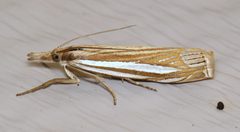
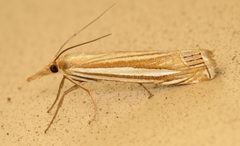
have a wingspan of 23–30 mm. The forewings are narrow and elongated, with a characteristic grass-veneer profile. Coloration is generally pale with subtle patterning typical of the . The body is slender, consistent with other Crambus .
Habitat
Grassland including meadows, prairies, lawns, and agricultural fields where grasses are abundant. are frequently encountered in open, sunny areas with dense grass cover.
Distribution
Eastern and central North America: recorded from Ontario and Maine south to South Carolina, west to Texas, and north to North Dakota. Additional records from Vermont confirm presence in New England.
Seasonality
are on wing from April to September, with peak activity likely varying by latitude. The extended period suggests multiple or continuous across the growing season.
Diet
Larvae feed on grasses (Poaceae). Specific grass have not been documented in the provided sources.
Life Cycle
Complete with , larval, pupal, and stages. Larvae are grass-feeders; likely occurs in soil or within grass thatch. Detailed timing is not documented.
Behavior
are and attracted to light. Larvae are concealed feeders within grass stems or thatch, typical of crambine grass-veneer moths.
Ecological Role
Larvae function as primary consumers in grassland , converting plant to animal tissue. They serve as prey for various including birds, , and other insects.
Human Relevance
Occasional minor pest in turfgrass and lawns due to larval feeding; generally not considered economically significant. are frequently observed and photographed by citizen scientists, with over 2,800 iNaturalist records contributing to distribution knowledge.
Similar Taxa
- Crambus spp.Other grass-veneer moths in the Crambus share similar size, shape, and preferences; many require genitalia examination for reliable separation.
- Fissicrambus spp.Related crambine with similar grass-feeding larvae and ; distinguished by subtle wing venation and genitalia characters.
More Details
Taxonomic history
Described by James Brackenridge Clemens in 1860, a prominent 19th-century American entomologist who described numerous North American Lepidoptera.
Citizen science value
With over 2,800 iNaturalist observations, this represents one of the better-documented North American crambid , aiding understanding of its and range limits.