
Petrophila
Guilding, 1830
Species Guides
15- Petrophila avernalis(Spring Petrophila)
- Petrophila bifascialis(two-banded petrophila moth)
- Petrophila canadensis(Canadian petrophila moth)
- Petrophila cappsi(Capps' Petrophila)
- Petrophila confusalis(confusing petrophila moth)
- Petrophila cronialis(Crony Petrophila)
- Petrophila daemonalis(Devil's River Petrophila)
- Petrophila fulicalis(Feather-edged Petrophila)
- Petrophila heppneri(Heppner's Petrophila)
Petrophila is a of aquatic in the Crambidae, described by Lansdown Guilding in 1830. The genus comprises approximately 30-40 distributed primarily in North America. Larvae are fully aquatic and inhabit flowing water systems, where they graze on and diatoms. are and typically found resting on rocks near water bodies. The genus has become a notable subject of citizen science research due to the cryptic nature of many species, which can be difficult to distinguish without detailed examination.
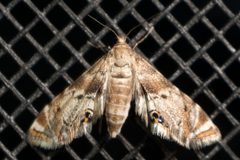
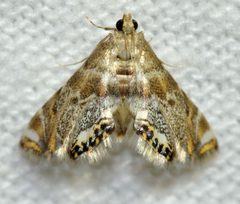
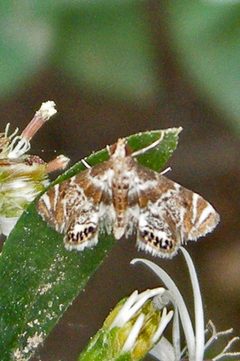
Pronunciation
How to pronounce Petrophila: /pɛˈtrɒfɪla/
These audio files are automatically generated. While they are not always 100% accurate, they are a good starting point.
Identification
-level identification within Petrophila relies heavily on wing pattern details, particularly the arrangement and intensity of dark longitudinal lines on the forewings. The Petrophila fulicalis species group presents particular challenges, with cryptic species distinguishable by subtle differences in forewing pattern elements, including the presence or absence of specific line fragments and the degree of contrast between light and dark areas. Genitalia dissection is often required for definitive identification. Citizen science photographic records have proven valuable for documenting distribution and facilitating identification when images capture diagnostic wing characters at sufficient resolution.
Images
Appearance
are small to medium-sized with wingspans typically ranging from 15-25 mm. Forewings are generally triangular with variable patterns of brown, gray, or white markings that often include distinct longitudinal lines or bands. Hindwings are usually paler and more uniform in coloration. are and relatively long. The body is slender and often covered with that give a somewhat metallic or iridescent sheen in some . Wing patterns are highly variable between species and frequently serve as the primary diagnostic characters for identification.
Habitat
Larvae inhabit lotic (flowing water) including streams, rivers, and creeks, where they live submerged on rocks and other substrates. are found in riparian zones, typically resting on rocks, boulders, or vegetation immediately adjacent to water bodies. The shows strong fidelity to aquatic throughout its .
Distribution
Primarily North American, with distributed across the United States, Canada, and Mexico. Individual species show varying range patterns, with some restricted to specific drainage systems while others are more broadly distributed. Citizen science data has documented range extensions and filled distributional gaps for several species.
Seasonality
periods vary by and latitude, with most activity occurring during warmer months. In temperate regions, adults are typically active from late spring through early fall, with peak often synchronized with seasonal water flow patterns and algal growth cycles.
Diet
Larvae feed on and diatoms growing on submerged rocks and other substrates in flowing water systems. do not feed; they rely on larval energy reserves.
Life Cycle
Complete with an aquatic larval stage. are laid on or near water, often on rocks or vegetation overhanging streams. Larvae are fully aquatic, breathing through tracheal gills, and pass through multiple instars while grazing on periphyton. occurs within a silken case attached to submerged substrates. emerge from the water and are terrestrial, though they remain closely associated with aquatic .
Behavior
are , unusual among , and are most active during daylight hours. They frequently rest on rocks near water with wings held flat or slightly tented. Males produce ultrasonic acoustic signals during courtship, a that has been studied in several . Adults are capable of rapid, darting when disturbed and often seek in vegetation or rock crevices.
Ecological Role
Larvae function as primary consumers in aquatic , grazing on algal and contributing to nutrient cycling in stream . They serve as prey for aquatic including fish and . provides a food source for riparian predators such as birds and spiders.
Human Relevance
Petrophila have become important subjects for citizen science and biodiversity documentation, with their aquatic requirements making them useful indicators of stream health. The has served as a model for studying cryptic species identification using photographic records. No significant economic impacts are known.
Similar Taxa
More Details
Taxonomic History
The was originally described by Lansdown Guilding in 1830. The placement has varied historically, with the group formerly placed in Nymphulinae and now in Acentropinae. concepts within the genus have been revised multiple times, with molecular data increasingly used to resolve cryptic .
Acoustic Communication
Male Petrophila produce ultrasonic courtship songs using specialized thoracic structures. This acoustic signaling is an important component of mate recognition and may contribute to reproductive isolation between cryptic .
Conservation Considerations
Aquatic requirements make Petrophila vulnerable to stream degradation, water pollution, and flow alteration. Several species have restricted distributions associated with specific watersheds.
Sources and further reading
- BugGuide
- Wikipedia
- iNaturalist taxon
- NCBI Taxonomy
- Catalogue of Life
- Mantispidae | Beetles In The Bush
- Insecta | Beetles In The Bush | Page 2
- On the chemistry and distribution of Cladonia petrophila
- Identification and Distribution of the Petrophila fulicalis Species Group (Crambidae): Taking Advantage of Citizen Science Data
- Aquatic Moths of the Genus Petrophila and their Biology in Oak Creek, Arizona (Crambidae)
- Kinetic and thermodynamic study of cloned thermostable endo-1,4-β-xylanase from Thermotoga petrophila in mesophilic host