
Petrophila confusalis
Walker, 1866
confusing petrophila moth
Petrophila confusalis is a semi-aquatic in the Crambidae, commonly known as the confusing petrophila moth. are small, with forewing lengths of 5–11 mm, and are active from April to September. The is notable for its specialized aquatic larval stage, during which caterpillars feed on and diatoms in fast-moving streams. The moth serves as a for the parasitic aquatic Tanychela pilosa and has been observed in large grazing zones that contribute to epilithic spatial patchiness. In 2021, it was listed on the Nevada Division of Natural Heritage watch list due to decline.
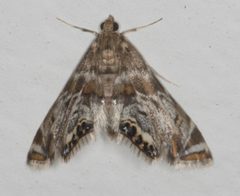
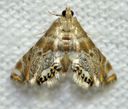
Pronunciation
How to pronounce Petrophila confusalis: /pɛˈtrɒfɪlə kənˈfjuːsælɪs/
These audio files are automatically generated. While they are not always 100% accurate, they are a good starting point.
Identification
Distinguished from similar Petrophila by a combination of size, wing pattern, and genitalia characteristics. The specific epithet "confusalis" reflects its historical taxonomic confusion with related species. Accurate identification typically requires examination of genitalia or molecular analysis.
Images
Habitat
Strictly associated with lotic (fast-moving) streams and their immediate riparian zones. Larvae inhabit the aquatic environment, grazing on -covered rocks. are found in riparian vegetation near streams.
Distribution
North America: British Columbia, California, Maryland, Minnesota, Montana, Nevada, Oregon, Texas, Washington, and Wyoming.
Seasonality
are on wing from April to September, with peak activity varying by latitude and elevation.
Diet
Larval stage: green and diatoms, specifically Cladophora, Synedra ulna, and Gomphonema olivaceum. diet not explicitly documented.
Life Cycle
Aquatic caterpillar stage feeds on and diatoms in streams. occurs in a cocoon, which may be parasitized by Tanychela pilosa. timing does not appear to be temperature-dependent, though warmer water negatively affects adult body size.
Behavior
Larvae form extensive "grazing zones" on rocks in streams, contributing to epilithic spatial patchiness. are and attracted to light.
Ecological Role
Primary consumer in stream through larval grazing on and diatoms. Serves as prey for small aquatic vertebrates and as for parasitic .
Human Relevance
Listed on the Nevada Division of Natural Heritage "Plant and animal watch list" in 2021 due to decline. Vulnerable to degradation from anthropogenic factors and climate change; warmer water temperatures reduce body size, potentially impacting .
Similar Taxa
- Other Petrophila species Petrophila contains multiple semi-aquatic with similar ; P. confusalis distinguished by size, wing pattern, and genitalia.