
Petrophila bifascialis
Robinson, 1869
two-banded petrophila moth
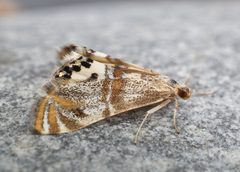
Petrophila bifascialis is a small crambid found across eastern and central North America. are active from late spring through early autumn. The is notable for its aquatic larval stage, which feeds on and diatoms in freshwater . Adults have a wingspan of 11–24 mm and display two distinct dark bands across the forewings.
Pronunciation
How to pronounce Petrophila bifascialis: //pɛˈtɹɒfɪlə ˌbaɪfaˈsɪeɪlɪs//
These audio files are automatically generated. While they are not always 100% accurate, they are a good starting point.
Identification
can be recognized by the two dark transverse bands on the forewings that give the its . The wingspan ranges from 11 to 24 mm. The forewings are pale with two prominent dark fasciae; the hindwings are lighter and less patterned. Similar Petrophila species may be distinguished by banding pattern and wing shape, though precise identification often requires examination of genitalia.
Images
Habitat
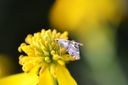
Larvae inhabit freshwater aquatic environments, including streams, rivers, and lakeshores, where they feed on submerged surfaces. are found in terrestrial near larval waters, including riparian zones and wetland edges.
Distribution
Eastern and central North America, from Nova Scotia south to Florida, west to Texas, and north to Ontario.
Seasonality
are on wing from late May through September, with peak activity varying by latitude.
Diet
Larvae feed on diatoms and . feeding habits are not well documented.
Life Cycle
Aquatic larvae develop on submerged substrates, feeding on microscopic and diatoms. occurs in or near the water. emerge and are active during warmer months.
Behavior
are and attracted to light. Larvae are fully aquatic, living on submerged rocks and vegetation where they graze on algal films.
Ecological Role
Larvae contribute to nutrient cycling in freshwater through their grazing on periphyton. They serve as prey for aquatic and small fish. may function as and are prey for including bats and birds.
Human Relevance
The has no significant economic impact. are occasionally encountered at lights by homeowners near water bodies. The aquatic larvae can serve as indicators of water quality in freshwater biomonitoring programs.
Similar Taxa
- Petrophila confusalisSimilar size and preference, but lacks the distinct two-banded forewing pattern of P. bifascialis; identification requires examination of genitalia
- Petrophila canadalisOverlapping range and aquatic larval habit; differs in forewing pattern with more diffuse or reduced banding