
Anthocharis thoosa inghami
Ingham's Orangetip
Anthocharis thoosa inghami is a of orangetip in the Pieridae. It is one of several recognized subspecies of Anthocharis thoosa, a distributed across western North America. Like other orangetips, are active in early spring and are associated with specific larval plants in the mustard family (Brassicaceae). The subspecies epithet 'inghami' honors a collector or researcher, following standard entomological naming conventions.
Pronunciation
How to pronounce Anthocharis thoosa inghami: //ænˈθoʊ.kəˌrɪs ˈθuː.sa ɪŋˈhæ.mi//
These audio files are automatically generated. While they are not always 100% accurate, they are a good starting point.
Identification
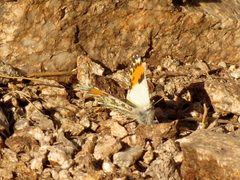
Distinguished from other Anthocharis thoosa by geographic distribution and subtle wing pattern variations. have white wings with orange tips on the forewings in males; females have reduced or absent orange markings. The is characterized by a falcate (hooked) forewing apex. Precise identification to subspecies level requires examination of genitalia or reference to specific locality data.
Images
Habitat
Associated with montane and foothill in its range. Larval plants are herbaceous in the mustard (Brassicaceae), typically found in open, rocky areas and meadows.
Distribution
Western North America; the subspecific distribution corresponds to a defined geographic region within the broader range of Anthocharis thoosa, though precise boundaries require literature.
Seasonality
active in early spring, typically March through May depending on elevation and local climate conditions. period coincides with availability of larval plants and nectar sources.
Diet
Larvae feed on flowers, buds, and young fruits of Brassicaceae . visit flowers for nectar; specific nectar sources have been observed to include spring-blooming herbaceous plants.
Host Associations
- Brassicaceae - larval plantflowers, buds, and young fruits
Life Cycle
Complete with four stages: , larva, pupa, . Larvae feed on developing reproductive structures of plants. occurs in a silken girdle attached to the host plant or nearby vegetation. Adults emerge in early spring and are , with one per year.
Behavior
Males patrol for females along ridges and hilltops, exhibiting ' ' without territorial defense. Rapid vertical chases between competing males have been observed when multiple males encounter the same female. are fast, erratic fliers that rarely perch for extended periods, making photography challenging.
Ecological Role
of early spring wildflowers. Larvae function as herbivores, consuming reproductive tissues of Brassicaceae. Serves as prey for birds, spiders, and insect .
Human Relevance
Subject of interest for collectors and photographers due to early spring and distinctive coloration. trends may serve as indicators of quality in montane .
Similar Taxa
- Anthocharis mideaSimilar (falcate orangetip) and appearance, but A. midea occurs in eastern North America and has different wing pattern details
- Anthocharis cethuraDesert orangetip with overlapping range in southwestern North America; distinguished by preference and subtle wing markings
- Anthocharis saraSara orangetip with coastal and montane western distribution; females have more extensive orange markings than most A. thoosa