
Papilio cresphontes
Cramer, 1777
eastern giant swallowtail, giant swallowtail, orangedog, orange dog, orange puppy, bird poop caterpillar
The eastern giant swallowtail (Papilio cresphontes) is the largest in North America, with females reaching wingspans up to 18 cm and males up to 19 cm. Its larvae, known as "orange dogs" or "orange puppies," are significant pests of citrus crops, though their remarkable camouflage as bird droppings and defensive osmeteria help them avoid . The has undergone rapid northern range expansion since 2001, linked to climate warming and reduced September frosts. Formerly considered to range across the Americas, western are now recognized as a separate species, Papilio rumiko.

Pronunciation
How to pronounce Papilio cresphontes: //pəˈpɪli.oʊ krɛsˈfɒntiːz//
These audio files are automatically generated. While they are not always 100% accurate, they are a good starting point.
Identification
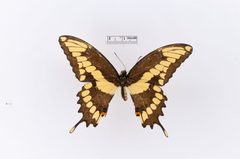
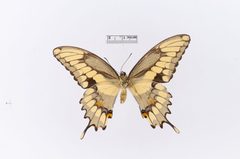
are distinguished by their exceptional size—females average 5.5 in (14 cm) wingspan, males 5.8 in (15 cm), with maximum recorded spans of 6.9 in (18 cm) and 7.4 in (19 cm) respectively. Wings are black with a horizontal yellow band across forewings and a diagonal yellow band on hindwings; underside is yellow with black accents. A small red patch within a blue band on the wing surface distinguishes it from the similar Schaus' swallowtail. Larvae resemble bird droppings in early instars, with coloration shifting through development; later instars display a saddle pattern thought to provide or snake mimicry.
Images
Habitat
In the United States, primarily inhabits deciduous forest and citrus orchards. is only possible in Florida and the deep South; northern expand seasonally but cannot persist through winter in colder regions.
Distribution
Eastern North America from southern New England and southern Canada south through the United States to Mexico, Jamaica, and Cuba. Northern boundary has expanded significantly since 2001 due to warming temperatures. Western North American and Central/South American formerly attributed to this are now classified as Papilio rumiko.
Seasonality
active during warmer months; northern range expansion enabled by larvae surviving early frosts before . as pupae restricted to southern regions.
Diet
Larvae feed on plants in Rutaceae, including native prickly ash (Zanthoxylum spp.), common hoptree (Ptelea trifoliata), and cultivated citrus (Citrus spp.), as well as introduced such as gasplant, rue, and sapote. nectar at flowers including , Azaleas, Bougainvillea, Saponaria officinalis, Hesperis matronalis, Solidago, Lonicera japonica, and Asclepias incarnata; also consume liquid from animal waste.
Life Cycle
Females lay single (1–1.5 mm, brownish-orange) on upper leaf surfaces of plants. Five larval instars reach approximately 2 inches before ; larvae are feeders. Pupation occurs on vertical plants or man-made objects, with chrysalis brown and mottled to resemble dead twig; pupal stage lasts 10–12 days. Males seek females along paths near host plants; copulation occurs in afternoon with pair facing away from each other.
Behavior
Larvae are primarily . When threatened, larvae evert orange/red Y-shaped osmeteria that emit bad-smelling, toxic acidic chemicals effective against small ; this defense is ineffective against birds. are strong fliers capable of gliding long distances with minimal wing beats due to large wingspan.
Ecological Role
Larval stage functions as herbivore, occasionally reaching pest status in citrus agriculture. Serves as for including Telenomus sp. (Scelionidae) and Brachymeria robusta. contribute to pollination through nectar feeding.
Human Relevance
Larvae are significant economic pests of citrus, particularly damaging to young trees and new foliage; large mature trees generally tolerate defoliation. "orange dog," "orange puppy," and "bird poop caterpillar" reflect agricultural and observational familiarity. Subject to biological and chemical control measures including Bacillus thuringiensis and methionine-based . Valued in gardens for aesthetic appeal and can be successfully reared from caterpillar to .
Similar Taxa
- Papilio rumikoFormerly considered ; western now separated based largely on evidence
- Papilio thoasClosely related member of same group; distinguished by presence of -spot on forewing and differences in male genitalia structure
- Schaus' swallowtailSimilar appearance; distinguished by absence of small red patch within blue band on wing surface
- Papilio glaucus (eastern tiger swallowtail)Large yellow-and-black swallowtail overlapping in range; P. cresphontes distinguished by size, band pattern orientation, and red patch
Sources and further reading
- BugGuide
- Wikipedia
- GBIF taxonomy match
- NCBI Taxonomy
- Catalogue of Life
- Lewis Ocean Bay Heritage Preserve & Wildlife Management Area | Beetles In The Bush
- Red-eyed poop! | Beetles In The Bush
- Archive — Bug of the Week
- Bug Eric: September 2010
- Giant Swallowtail, Orangedog, Papilio cresphontes Cramer (Insecta: Lepidoptera: Papilionidae)
- Host Plant Suitability and a Test of the Feeding Specialization Hypothesis Using <i>Papilio Cresphontes</i> (Lepidoptera: Papilionidae)
- Telenomus sp. (hymenoptera: scelionidae) un parasitoide del gusano perro (papilio cresphontes) en huertas de limón persa citrus x latifolia
- Climate Change and Local Host Availability Drive the Northern Range Boundary in the Rapid Expansion of a Specialist Insect Herbivore, Papilio cresphontes