
Papilio rumiko
(Shiraiwa & Grishin, 2014)
western giant swallowtail
Papilio rumiko, the western giant swallowtail, is a large recognized in 2014 based on evidence, having been previously confused with Papilio cresphontes. It ranges from the southwestern United States through Mexico and Central America to Panama. The species exhibits classic giant swallowtail with distinctive yellow banding patterns and maroon eyespots on the hindwings.

Pronunciation
How to pronounce Papilio rumiko: /pəˈpiːlioʊ ˈruːmɪˌkoʊ/
These audio files are automatically generated. While they are not always 100% accurate, they are a good starting point.
Identification
Distinguished from the similar eastern giant swallowtail (Papilio cresphontes) by the dark oval spot on the forewing that interrupts or borders the central yellow band, and by the reduced or absent marginal pale spots at the dips. The tornal eyespot coloration and tail tip pattern also differ. Identification requires close examination of wing pattern elements; genetic analysis confirmed the distinction.
Images
Appearance
Large swallowtail with forewing length 50–58 mm. Forewings display two maize-yellow bands: a central band of nine spots running from apex to basal third at inner margin, and a submarginal band of three to seven spots. Several smaller maize-yellow spots occur near the at the end of the . A dark oval spot of variable size is present inside or at the edge of the central yellow band spot, sometimes dividing it. Marginal pale spots at dips are small or nearly absent. Hindwings bear two maize-yellow bands continuous from forewings, a maroon-red to orange-red eyespot near the tornus with a blue crescent above, and a yellow-centered tail tip.
Habitat
Associated with plants in the Rutaceae , including Zanthoxylum fagara, Ptelea trifoliata, Amyris texana, Casimiroa greggii, Ruta graveolens, and various Citrus . Occurs in environments supporting these larval food plants, which include woodland edges, riparian areas, and cultivated settings where citrus and related plants grow.
Distribution
Southwestern United States (northernmost record in northeastern Colorado) south through Mexico, El Salvador, Honduras, Rica to Panama.
Diet
Larvae feed on leaves and shoots of Rutaceae: Zanthoxylum fagara, Ptelea trifoliata, Amyris texana, Casimiroa greggii, Ruta graveolens, and Citrus . feeding habits not specified in sources.
Host Associations
- Zanthoxylum fagara - larval plant laid on young leaves and shoots
- Ptelea trifoliata - larval plant laid on young leaves and shoots
- Amyris texana - larval plant laid on young leaves and shoots
- Casimiroa greggii - larval plant laid on young leaves and shoots
- Ruta graveolens - larval plant laid on young leaves and shoots
- Citrus - larval plant laid on young leaves and shoots; unspecified
Life Cycle
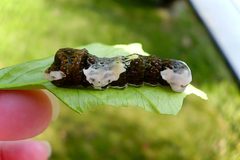
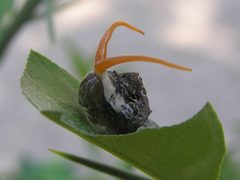
laid singly, pale yellow when laid, changing to dull orange-brown. First instar 3–5 mm with yellow-brown , body resembling bird droppings. Second instar 5–11 mm with uniformly brownish head. Third instar 11–16 mm, fourth 16–30 mm, fifth instar 30–50 mm. Late instar larvae lift head and inflate when startled, revealing eyespots; further disturbance triggers eversion of red osmeterium. Early instars use osmeterium immediately when disturbed; first instar osmeterium yellowish. Pupa 26–36 mm, mottled pale to greyish and dark brown, coloration influenced by substrate color.
Behavior
Late instar larvae perform defensive display: lifting , inflating to expose eyespots, and everting red osmeterium if disturbance continues. Early instars evert osmeterium immediately without preliminary display. occurs on tree or branch surfaces; pupal coloration matches substrate through phenotypic plasticity.
Similar Taxa
- Papilio cresphontesHistorically confused with P. rumiko; distinguished by wing pattern details including presence and position of dark oval spot on forewing and marginal spot development
Misconceptions
Was known for over a century as Papilio cresphontes; only recognized as a distinct in 2014 based on evidence.
More Details
Taxonomic history
Described in 2014 by Shiraiwa & Grishin; named in honor of the wife of the first author. Member of the Papilio thoas group. Basionym Heraclides rumiko.
Sources and further reading
- BugGuide
- Wikipedia
- GBIF taxonomy match
- NCBI Taxonomy
- Bird droppings, snake eyes, dead leaves: Swallowtails, Papilio spp. — Bug of the Week
- Papilionoidea | Blog
- Swallowtails where art thou? Swallowtail butterflies, Papilionidae — Bug of the Week
- Parsley poacher: Black swallowtail caterpillar, Papilio polyxenes — Bug of the Week
- Swallowtail soiree - Papilio glaucus — Bug of the Week
- Swallowtail soiree – Eastern tiger swallowtail, Papilio glaucus — Bug of the Week