
Papilio glaucus
Linnaeus, 1758
Eastern Tiger Swallowtail, Tiger Swallowtail
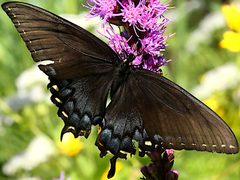
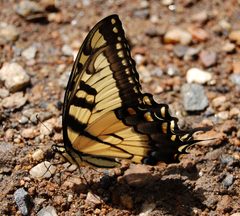
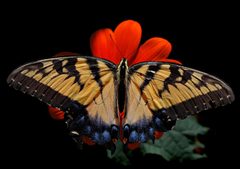
Papilio glaucus, the eastern tiger swallowtail, is a large and familiar native to eastern North America. are recognized by their distinctive yellow and black tiger-striped pattern; males are consistently yellow with four black stripes on each forewing, while females exhibit dimorphism with both yellow and dark morphs. The is notable for its remarkable caterpillar defenses, including bird-dropping mimicry in early instars and snake-mimicry eyespots in later stages. Dark-morph females employ of the unpalatable pipevine swallowtail. The butterfly is highly as a larva, feeding on numerous tree species across multiple plant , and is an important as an adult. It produces two to three annually and is active from spring through fall.
Pronunciation
How to pronounce Papilio glaucus: //pəˈpɪli.oʊ ˈɡlɔːkəs//
These audio files are automatically generated. While they are not always 100% accurate, they are a good starting point.
Identification
Distinguished from similar swallowtails by the broken yellow bar on the forewing margin, present in both sexes. Dark morph females can be separated from pipevine swallowtail (Battus philenor) by the row of light-colored spots on wing margins; from spicebush swallowtail (Papilio troilus) by less greenish coloration and single row of orange spots on ventral hindwing (versus two rows); and from black swallowtail (Papilio polyxenes) by larger size and single row of orange spots on ventral hindwing (versus two rows of yellow-orange spots). The closely related Canadian tiger swallowtail (P. canadensis) and Appalachian tiger swallowtail (P. appalachiensis) differ in size and have a solid yellow bar on the ventral forewing margin rather than broken. P. canadensis is smaller with non-dimorphic females; P. appalachiensis is larger with females rarely black.
Images
Habitat
Occurs in almost any where deciduous forests are present, including woodlands, fields, riversides, creeks, roadsides, and gardens. Will stray into urban parks and residential yards. Adapted to many different habitats and plants, functioning as a habitat .
Distribution
Eastern United States from southern Vermont south to Florida, west to eastern Texas and the Great Plains. Rarer in southern Florida and absent from the Florida Keys. Northern range extends to southern Ontario, Canada. Formerly considered to range into northern Canada until the P. g. canadensis was elevated to level in 1991, restricting P. glaucus to south of Canada.
Seasonality
active from spring through fall; timing varies by latitude. In the southern portion of range, observed from February to November; in the north, from May to September. Produces two in northern areas and three broods in southern areas. First brood yields smallest adults. occurs as pupae in cold-winter locations.
Diet
feed on nectar from many flower , with preference for sturdy plants with red or pink flowers. Common nectar sources include members of Apocynaceae, Asteraceae, and Fabaceae. Larvae feed on leaves of plants, with notable polyphagy across multiple plant .
Host Associations
- Liriodendron tulipifera - larval Tulip tree/tulip poplar; preferred with highest larval survival rates
- Prunus serotina - larval Wild black cherry; common plant
- Magnolia virginiana - larval Sweet bay magnolia
- Fraxinus - larval Ash
- Populus - larval Cottonwood
- Ptelea trifoliata - larval Wafer ash or hoptree
- Syringa vulgaris - larval Common lilac
- Salix - larval Willow
- Lauraceae - larval level association
- Oleaceae - larval level association
- Rutaceae - larval level association
- Tilioideae - larval level association
Life Cycle
Complete with , five larval instars, pupa, and stages. Eggs hatch in 3–5 days (4–10 days range reported). Larval stage includes five instars; early instars (1–3) are brown and white bird-dropping mimics, fourth and fifth instars are green with snake-mimicry eyespots. Caterpillar rests on silk pad with leaf edges folded over and held with silk. occurs after caterpillar turns brown; chrysalis stage lasts 9–11 days, or extends through winter hibernation in cold climates. Adults live only a few days in the wild. Two to three per year depending on latitude.
Behavior
and usually solitary. fly high above ground, frequently seen above tree . Males patrol containing larval plants to locate females. During courtship, males and females fly about each other before landing and mating; males release to entice females. Males engage in puddling , congregating on mud, damp gravel, or puddles to extract sodium ions and that aid ; males typically puddle only during first few days after . Females occasionally puddle but do not form congregations. Adults have been observed feeding on , carrion, and urine in addition to nectar.
Ecological Role
Important of diverse flowering plants. Larvae serve as food source for various including birds, reptiles, and small mammals, though their mimicry defenses reduce pressure. Dark morph females participate in mimicry complex with unpalatable pipevine swallowtail, potentially reinforcing predator avoidance learning. Caterpillar plant use patterns influence detoxication evolution and may affect plant chemical .
Human Relevance
State of Alabama, Delaware, Georgia, North Carolina, and South Carolina; state insect of Virginia. Popular and familiar garden butterfly, frequently observed in suburban and urban settings. Subject of extensive scientific research on mimicry, plant relationships, and ecological . First North American butterfly depicted in art (John White, 1587, 'Mamankanois').
Similar Taxa
- Papilio canadensisFormerly considered a ; smaller size, non-dimorphic females, solid yellow bar on forewing (not broken), and more northern distribution
- Papilio appalachiensisRecently described from southern Appalachians; larger size, females rarely black, solid yellow bar on forewing, and distinct geographic range
- Battus philenorPipevine swallowtail mimicked by dark morph females; distinguished by row of light-colored spots on wing margins and unpalatability due to aristilochic acids
- Papilio troilusSpicebush swallowtail; more greenish coloration, two rows of orange spots on hindwing, and different plant associations
- Papilio polyxenesBlack swallowtail; smaller size, two rows of yellow-orange spots on hindwing, and different plant preferences (Apiaceae)
More Details
Gynandromorphs
One of few papilionid known to produce gynandromorphs (individuals with both male and female characteristics). Most bilateral gynandromorphs are hybrids of P. glaucus and P. canadensis found along hybrid zones. Color mosaics occur in central part of species range.
Detoxication Enzymes
Larvae exhibit significant plant-induced variation in detoxication activity. O-demethylase activity varies up to 16-fold, microsomal esterase up to 6-fold, and microsomal glutathione transferase almost 5-fold among larvae fed different host plants. Overall detoxication enzyme activity is highest in larvae fed tulip tree and lowest in those fed basswood, correlating with larval performance.
Puddling Behavior
Males are attracted to sand soaked with dilute aqueous solutions of sodium salts; sodium ion concentration of 10^-3 molar is sufficient to stimulate puddling. Sodium acquisition appears to be the main ecological function of this .
Hybridization
Hybridizes with P. canadensis along a narrow zone where ranges overlap, with hybrid individuals showing intermediate characteristics.
Sources and further reading
- BugGuide
- Wikipedia
- GBIF taxonomy match
- iNaturalist taxon
- NCBI Taxonomy
- Catalogue of Life
- Bird droppings, snake eyes, dead leaves: Swallowtails, Papilio spp. — Bug of the Week
- Papilionidae | Beetles In The Bush
- Bug Eric: City Nature Challenge 2024 Recap
- Day hike at Little Lost Creek Conservation Area | Beetles In The Bush
- Archive — Bug of the Week
- Swallowtail soiree - Papilio glaucus — Bug of the Week
- The mating behavior of Papilio glaucus (Papilionidae)
- Host plant alteration of detoxication activity in Papilio glaucus glaucus
- Tiger Swallowtail, Eastern Tiger Swallowtail, Papilio glaucus Linnaeus (Insecta: Lepidoptera: Papilionidae)
- Phenotypic Plasticity of Host Selection in Adult Tiger Swallowtail Butterflies, Papilio glaucus L. (Lepidoptera: Papilionidae)
- POPULATION STRUCTURE AND HOST USE IN HYBRIDIZING SUBSPECIES OFPAPILIO GLAUCUS(LEPIDOPTERA: PAPILIONIDAE)
- Speciation in Butterflies of the Papilio glaucus Group. II. Ecological Relationships and Interspecific Sexual Behavior
- Temperature as a Factor in the Development and Feeding Ecology of Tiger Swallowtail Caterpillars, Papilio glaucus (Lepidoptera)
- Absence of Behavioral Induction in Oviposition Preference of <i>Papilio Glaucus</i> (Lepidoptera: Papilionidae)
- CYP6B cytochrome P450 monooxygenases from Papilio canadensis and Papilio glaucus : potential contributions of sequence divergence to host plant associations
- Sodium: Stimulus for Puddling Behavior by Tiger Swallowtail Butterflies, Papilio glaucus