
Papilio troilus
Linnaeus, 1758
Spicebush Swallowtail, Green-clouded Butterfly
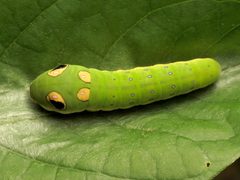
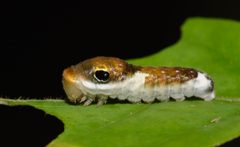
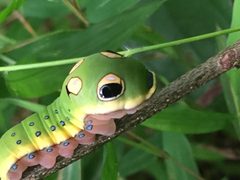
Papilio troilus, the spicebush swallowtail, is a black swallowtail native to eastern North America. are primarily black with distinctive green-blue (male) or bright blue (female) half-moon markings on the hindwings, along with cream-yellow spots and orange basal patches. The exhibits two : the widespread P. t. troilus and the Florida- P. t. ilioneus. Larvae are notable for their dramatic ontogenetic color change, shifting from bird-dropping mimicry in early instars to snake-mimicry with large eyespots in later stages.
Pronunciation
How to pronounce Papilio troilus: //pəˈpɪlioʊ ˈtrɔɪləs//
These audio files are automatically generated. While they are not always 100% accurate, they are a good starting point.
Identification
Distinguished from similar black swallowtails by the dual row of orange spots on the underside of the hindwing (single row in pipevine swallowtail, Battus philenor). The discontinuous orange spots with blue/green medial spread are diagnostic. Females show brighter blue hindwing markings than males; summer females develop greenish-white basal spots. P. t. ilioneus (Florida) shows yellow rather than blue hindwing spots with blue tail extensions. is characteristically low and fast through shaded areas, unlike other swallowtails that fly at greater heights.
Images
Appearance
have a wingspan of 7.6–10.2 cm. Forewings are dark brown to black with cream-colored oval spots along the outer margin; middle spots may appear moon-shaped and light blue. Hindwings display a green-blue (male) or bright blue (female) half-moon splotch, cream-yellow moon-shaped marginal spots, and a bright orange spot at the wing base—this spot turns greenish-white in females during summer. Underside of hindwing shows a dual row of orange spots with blue or green between them; orange spots are characteristically discontinuous. P. t. ilioneus differs in having more yellow (less blue) hindwing spots and blue coloration extending down the tail. Adults have club-like hindwing extensions that function as false to divert attacks.
Habitat
Deciduous woods and woody swamps, particularly areas with Lauraceae plants. Males frequent swampy areas while females prefer open plains within forested regions. are not geographically limited in within their range, moving according to water, nectar, and mate availability. Temperature extremes limit distribution: adults fare poorly above 36°C or below 14°C.
Distribution
Eastern United States from New England to Wisconsin, west to Illinois, North Dakota, Nebraska, Texas, and Colorado; southern Ontario; occasional strays to the American plains states, Cuba, Manitoba, and Colorado. P. t. ilioneus is restricted to the Florida peninsula and coastal Georgia.
Seasonality
active February through November in most of range; three per year. Complete development from to adult takes approximately one month. Pupae overwinter, with termination determined by temperature and induction by —responses vary latitudinally.
Diet
Larvae are herbivores of Lauraceae, primarily feeding on spicebush (Lindera benzoin) and sassafras (Sassafras albidum); also recorded on tulip tree (Liriodendron tulipifera), sweetbay (Magnolia virginiana), camphor (Cinnamomum camphora), redbay (Persea borbonia), swampbay (Persea palustris), and prickly ash (Zanthoxylum). Performance is poor on hairy-leaved . feed on nectar from diverse sources including Joe-Pye weed, jewelweed, honeysuckle, , thistles, milkweeds, azalea, dogbane, mimosa, and sweet pepperbush.
Host Associations
- Lindera benzoin - primary larval Spicebush, namesake of the ; preferred oviposition site
- Sassafras albidum - primary larval Sassafras; contains oviposition stimulant 3-trans-caffeoyl-muco-quinic acid
- Persea borbonia - secondary larval Redbay; primary for P. t. ilioneus, poor growth for P. t. troilus
- Persea palustris - secondary larval Swampbay; used by P. t. ilioneus
- Liriodendron tulipifera - occasional larval Tulip tree
- Magnolia virginiana - occasional larval Sweetbay
- Cinnamomum camphora - occasional larval Camphor tree
- Zanthoxylum - occasional larval Prickly ash
Life Cycle
Females drum forelegs with to assess leaf chemistry before ovipositing one or two greenish-white on leaves. First instar larvae are brownish, resembling bird droppings; they clip and fold leaf edges to create silk-lined shelters, feeding nocturnally. When disturbed, they emit foul-smelling substances. Later instars turn greenish-yellow with large black eyespots with white highlights on the , mimicking snakes; they retract their actual and extend a red, forked osmeterium to enhance the snake illusion. occurs on the underside of low leaves; pupae are green in summer, brown in winter (seasonal ), matching host plant foliage color. live 2–14 days depending on resources and .
Behavior
characteristically flutter wings while feeding. is low and fast through shaded understory. Adults engage in puddling—gathering in groups on moist soil or sand near water to extract moisture and minerals. Courtship involves elaborate visual displays with male-female contact; males emit around females, who use scent to assess mates. Both sexes mate multiply, though female remating probability declines with each mating. Females preferentially oviposit on Sassafras and Lindera even when rare, rejecting abundant Persea. Larvae are hiders and feeders; they thermoregulate effectively due to dark coloration, enabling activity at lower temperatures than .
Ecological Role
Specialized herbivore of Lauraceae; exhibits resource partitioning with Papilio palamedes, which dominates on Persea while P. troilus dominates on Sassafras and Lindera. serve as . Larvae are prey for birds, spiders, robber flies, and ; their mimicry defenses may influence foraging . mutualism not reported for this species (unlike some treehoppers).
Human Relevance
Popular among gardeners and naturalists; larvae sometimes considered pests in herb gardens but rarely cause significant economic damage. frequently observed in butterfly gardens and natural areas. Used in ecological research on plant specialization, mimicry, and phenotypic plasticity. Educational value for teaching -prey dynamics and evolutionary adaptations.
Similar Taxa
- Papilio palamedesPalamedes swallowtail; also black with blue markings and feeds on Lauraceae, but uses Persea as primary where P. troilus is rare; single row of orange spots on hindwing underside
- Battus philenorPipevine swallowtail; model for —P. troilus resembles this foul-tasting but has dual (not single) row of orange hindwing spots and brighter female coloration
- Papilio polyxenesBlack swallowtail; similar size and coloration but with more extensive yellow banding on wings; larvae feed on Apiaceae (carrot ), not Lauraceae; different plant preferences
- Papilio glaucusEastern tiger swallowtail; much larger with bold yellow and black tiger striping (dark morph females resemble black swallowtails but lack blue half-moon markings); more use
More Details
Osmeterial Defense Chemistry
Larvae possess retractable osmeteria that secrete defensive compounds. Early instars produce terpenoid secretions; late instars switch to aliphatic acids, potentially reflecting different pressures or plant chemistry across development.
Host Plant Chemistry and Oviposition
The compound 3-trans-caffeoyl-muco-quinic acid from sassafras leaves acts as an oviposition stimulant, though it is absent from other major like spicebush and redbay. This hydroxycinnamic acid may activate other compounds that trigger -laying, explaining why some females prefer sassafras despite its rarity in some .
Subspecies Differentiation
P. t. ilioneus is smaller than P. t. troilus, with yellow rather than blue hindwing spots and blue coloration extending onto the tail. The is adapted to Florida's redbay-dominated plant , showing higher growth and survival on Persea than the nominate subspecies, though both perform better on sassafras or spicebush overall.
Sources and further reading
- BugGuide
- Wikipedia
- GBIF taxonomy match
- iNaturalist taxon
- NCBI Taxonomy
- Catalogue of Life
- Red-eyed poop! | Beetles In The Bush
- Archive — Bug of the Week
- Yellow snake along the trail: Spicebush swallowtail caterpillar, Papilio troilus — Bug of the Week
- Bird droppings, snake eyes, dead leaves: Swallowtails, Papilio spp. — Bug of the Week
- Papilionoidea | Blog
- Parsley poacher: Black swallowtail caterpillar, Papilio polyxenes — Bug of the Week
- Spicebush Swallowtail Papilio (Pterourus) troilus Linnaeus 1758 (Insecta: Lepidoptera: Papilionidae: Papilioninae)
- Differential Use of Lauraceous Hosts by Swallowtail Butterflies, Papilio troilus and P. palamedes (Papilionidae)
- Host Pubescence and the Behavior and Performance of the ButterflyPapilio Troilus(Lepidoptera: Papilionidae)
- Host Pubescence and the Behavior and Performance of the Butterfly <I>Papilio Troilus</I> (Lepidoptera: Papilionidae)