
Papilio palamedes
Drury, 1773
Palamedes swallowtail, laurel swallowtail
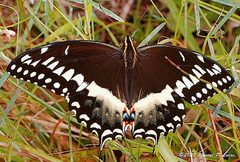
Papilio palamedes is a large native to southeastern North America, distinguished by bold yellow bands on dark wings. Larvae feed almost exclusively on Lauraceae, particularly Persea . The species conservation pressure from laurel wilt , which has devastated its primary plant Persea borbonia. are active from spring through late fall, with two to three per year. The chrysalis overwinters.
Pronunciation
How to pronounce Papilio palamedes: //pəˈpɪli.oʊ ˌpæləˈmiːdiːz//
These audio files are automatically generated. While they are not always 100% accurate, they are a good starting point.
Identification
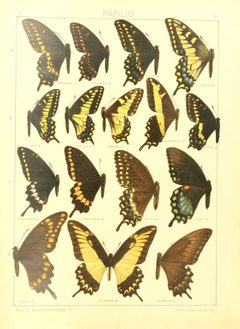
Distinguished from Papilio troilus (spicebush swallowtail) by larval preference (Persea vs. Lindera benzoin and Sassafras albidum) and larval : P. palamedes has smaller false eyespots and smaller blue spots on . differ from P. troilus in banding pattern on hindwing underside. Distinguished from Papilio cresphontes (giant swallowtail) by smaller size and different wing pattern.
Images
Habitat
Cypress swamplands, coastal swamplands, wet riparian forests, bay forests, and savannas in the southeastern United States and adjacent regions. Associated with pine flatlands containing wetland features such as bogs and bays. Requires presence of Lauraceae plants.
Distribution
Southeastern United States from southeastern Virginia southward; northeastern Mexico (represented by P. p. leontis). Range corresponds to distribution of primary plants Persea borbonia and Persea palustris.
Seasonality
May to October in southeastern Virginia; March to December in more southern regions. Two to three per year. Chrysalis overwinters.
Diet
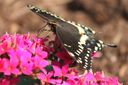
Larvae feed on foliage of Lauraceae: primarily Persea borbonia (redbay), Persea palustris (swampbay), and Sassafras albidum (white sassafras). feed on nectar; longer enables specific plant- relationships with Platanthera ciliaris in coastal-plain .
Host Associations
- Persea borbonia - Primary larval Redbay; severely impacted by laurel wilt
- Persea palustris - Larval Swampbay
- Sassafras albidum - Larval White sassafras
- Cinnamomum camphora - Potential larval camphor tree; larvae can develop on foliage but females show no oviposition preference
- Platanthera ciliaris - nectar sourceYellow fringed orchid; facilitated by long
Life Cycle
pale greenish-yellow, laid singly on plant leaves. Larva green with two false eyespots on and blue spots on first through eighth abdominal segments; constructs leaf shelter. Green chrysalis with whitish lateral stripe edged with brown above and two horns on ; overwinters. Two to three per year in most of range.
Behavior
Males patrol near forest edges and openings to locate females. Courtship involves male and female flying about 30 cm apart in slow unison; male then flies above and behind female to disperse until female accepts or rejects. Females show strong oviposition fidelity to native Lauraceae and do not preferentially lay on Cinnamomum camphora despite its suitability for larval development.
Ecological Role
Larval herbivore on Lauraceae; contributes to nutrient cycling in wetland forest . , particularly of Platanthera ciliaris. Potential for -switching following disturbance events affecting primary host .
Human Relevance
Subject of conservation concern due to laurel wilt impacts on primary Persea borbonia. Used in studies of host-plant relationships and insect-plant . Observed by naturalists in southeastern US wetland .
Similar Taxa
- Papilio troilusLarva nearly identical but has larger false eyespots, larger blue spots, and different preferences (Lindera benzoin, Sassafras albidum); in coastal Southeast, P. t. ilioneus shares Persea borbonia as host
- Papilio cresphontesLarger giant swallowtail with different wing pattern; P. palamedes appears smaller and has distinct hindwing banding
More Details
Laurel wilt disease impact
The Raffaelea lauricola, transmitted by the redbay ambrosia beetle, has caused widespread mortality of Persea borbonia across the southeastern US. Research indicates P. palamedes larvae can develop on Cinnamomum camphora, the only LWD- Lauraceae in the region, but -switching is constrained by female oviposition rather than larval performance. Stump sprouts from LWD-infected P. borbonia trees support higher larval growth rates than C. camphora.
Subspecies
P. p. leontis Rothschild & Jordan, 1906 occurs in northeastern Mexico.
Sources and further reading
- BugGuide
- Wikipedia
- GBIF taxonomy match
- iNaturalist taxon
- NCBI Taxonomy
- Catalogue of Life
- Lewis Ocean Bay Heritage Preserve & Wildlife Management Area | Beetles In The Bush
- Potential for host shifting in Papilio palamedes following invasion of laurel wilt disease
- Differential Use of Lauraceous Hosts by Swallowtail Butterflies, Papilio troilus and P. palamedes (Papilionidae)