
Papilio appalachiensis
(Pavulaan & Wright, 2002)
Appalachian Tiger Swallowtail
Papilio appalachiensis is a to the Appalachian Mountains of eastern North America. It originated through hybrid speciation between Papilio canadensis and Papilio glaucus, and is now recognized as a distinct with stable at higher elevations. are notably larger than both parental species, with wingspans of 86–115 mm. The species is , with adults emerging in May and females ovipositing during a brief spring period.
Pronunciation
How to pronounce Papilio appalachiensis: //pəˈpɪ.li.oʊ əˌpæ.ləˈkaɪ.en.sɪs//
These audio files are automatically generated. While they are not always 100% accurate, they are a good starting point.
Identification
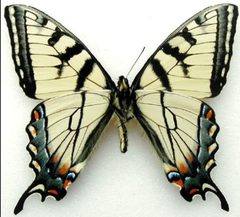
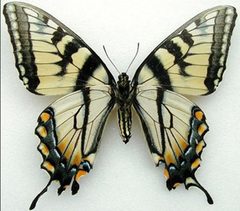
Distinguished from P. glaucus and P. canadensis by larger overall size, more angular wing margins, narrower black forewing stripes, and less curved hindwing scallops. Hindwing spots are rectangular rather than crescent-shaped. Reduced blue scaling on hindwing upperside compared to parental . period in May is earlier than P. glaucus and later than P. canadensis. Occurs at higher elevations than P. glaucus, with range centered on Appalachian Mountains rather than coastal or northern regions.
Images
Habitat
Mid-level to high elevations in the southern Appalachian Mountains, primarily in deciduous hardwood forests. remain in the and only descend to visit flowers. Found in woodlands and woodland openings, with notably concentrated at higher elevations though occasionally occurring in valleys within mountainous terrain.
Distribution
Eastern United States, specifically the Appalachian Mountains from Pennsylvania south to Georgia and Alabama. Core range lies within the hybrid zone between P. canadensis and P. glaucus distributions.
Seasonality
. emerge in May; period extends from May to early June, with some individuals flying into late June. Females oviposit in May. occurs late June to July, with pupae entering through winter until the following spring.
Diet
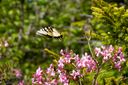
feed on nectar from mountain laurel (Kalmia latifolia), pink azalea (Rhododendron nudiflorum), blackberry (Rubus), cockspur thorn (Crataegus crus-galli), multiflora rose (Rosa multiflora), bush honeysuckle (Diervilla), autumn olive (Elaeagnus commutata) at higher elevations, and daisy fleabane (Erigeron ramosus) at lower elevations. Larvae feed on leaves of black cherry (Prunus serotina), tulip tree (Liriodendron tulipifera), cottonwood (Populus), and lemon (Citrus).
Life Cycle
laid singly on plant leaves in May. Larvae hatch and consume host foliage, constructing leaf shelters. occurs in late June to July; pupae overwinter in . Development from egg to requires approximately one month. Adults emerge the following May. Single per year.
Behavior
Males patrol treetops during mating season to locate females. Females are difficult to detect, remaining concealed in forest except when descending to oviposit or feed. make exceeding 200 km. At high-elevation sites such as Spruce Knob, adults fly directly up western slopes against prevailing westerly winds to reach summit vegetation where they rest and nectar.
Ecological Role
butterflies function as of montane flowering plants. Larvae serve as herbivores in forest . The occupies a distinct thermal at higher elevations, facilitating coexistence with parental species through partitioning.
Human Relevance
Subject of research interest due to its status as a documented case of hybrid speciation in animals. Observed by naturalists and enthusiasts in Appalachian Mountain parks and forests. Potential for climate-driven range shifts, as its distribution is tied to specific thermal landscapes.
Similar Taxa
- Papilio glaucusOverlaps in general appearance and geographic range, but P. appalachiensis is larger, has more angular wings with narrower stripes and less curved hindwing scallops, and occurs at higher elevations with a rather than .
- Papilio canadensisShares and cooler-climate , but P. appalachiensis is larger, has reduced blue hindwing scaling, and occurs farther south in the Appalachians rather than in northern forests.
Misconceptions
Originally believed to lack a black female form; this was later disproven with documentation of melanic females at high-elevation sites. Some sources may still incorrectly treat it as a hybrid rather than a stabilized .
Sources and further reading
- BugGuide
- Wikipedia
- GBIF taxonomy match
- iNaturalist taxon
- NCBI Taxonomy
- Bird droppings, snake eyes, dead leaves: Swallowtails, Papilio spp. — Bug of the Week
- Papilionoidea | Blog
- Swallowtails where art thou? Swallowtail butterflies, Papilionidae — Bug of the Week
- Parsley poacher: Black swallowtail caterpillar, Papilio polyxenes — Bug of the Week
- Swallowtail soiree - Papilio glaucus — Bug of the Week
- Swallowtail soiree – Eastern tiger swallowtail, Papilio glaucus — Bug of the Week