
Papilio canadensis
Rothschild & Jordan, 1906
Canadian Tiger Swallowtail
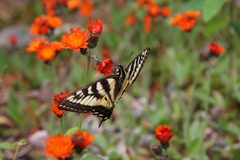
A medium-sized with yellow and black striped wings, found across northern North America. fly during spring and summer with a single . The was formerly considered a of Papilio glaucus but is now recognized as distinct based on morphological and genetic differences. It exhibits regional to climate, with northern showing faster development rates in cooler temperatures.

Pronunciation
How to pronounce Papilio canadensis: /pəˈpiː.li.oʊ kæ.nəˈdɛn.sɪs/
These audio files are automatically generated. While they are not always 100% accurate, they are a good starting point.
Identification
Distinguished from the eastern tiger swallowtail (Papilio glaucus) by smaller size (67–80 mm vs. 75–140 mm), continuous yellow marginal band on forewing underside (broken in P. glaucus), and more extensive orange hindwing scaling. Distinguished from western tiger swallowtail (Papilio rutulus) by geographic range and wing pattern details. Hybridization with both P. glaucus and P. rutulus has been documented but is extremely rare.
Images
Habitat
Woodland edges, deciduous and mixed forests, riparian areas, and open areas near forest. Common around woodland edges where frequently puddle.
Distribution
Canada: most provinces and territories, ranging north of the Arctic Circle in Yukon, to Churchill (Manitoba), Little Shagamu River (Ontario), and Schefferville (Quebec). Absent from southern British Columbia (replaced by P. rutulus) and parts of southwestern Ontario west of Toronto (replaced by P. glaucus). Present in western and central Newfoundland; unreported from Labrador. United States: northern third of the country.
Seasonality
active during spring and summer. One per year. Adults emerge in May; period extends through summer months. Pupae overwinter.
Diet
feed on nectar. Larvae feed on leaves of woody plants: Betula (birches), Populus (poplars, aspens, cottonwoods), Malus (apple), and Prunus serotina (black cherry).
Host Associations
- Betula - larval plantbirches
- Populus - larval plantpoplars, aspens, cottonwoods
- Malus - larval plantapple trees
- Prunus serotina - larval plantblack cherry
Life Cycle
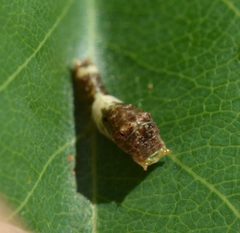
Single (). Females lay singly on plant leaves. Larvae fold and tie host plant leaves together with silk to create feeding shelters. Caterpillars progress through five instars; early instars brown and white, mimicking bird droppings; later instars green with yellow dots and false eyespots with bluish centers, appearing snake-like in profile. Pupae overwinter, with emerging in May.
Behavior
frequently engage in puddling , gathering in large numbers (sometimes hundreds) at single puddles to obtain minerals. One of the most popular puddling within its range. Larvae construct leaf shelters by folding and tying leaves with silk.
Ecological Role
Herbivore as larva; as . Subject to competition with gypsy moth (Lymantria dispar) mediated by plant chemistry, , and .
Human Relevance
Popular and well-known in northern North America. Frequently observed by naturalists and butterfly enthusiasts. Subject of ecological research on climate and plant associations.
Similar Taxa
- Papilio glaucusOverlaps in range in some areas; distinguished by larger size (75–140 mm), broken yellow marginal band on forewing underside, and less extensive orange hindwing scaling
- Papilio rutulusReplaces P. canadensis in southern British Columbia; distinguished by geographic separation and subtle wing pattern differences
Misconceptions
Formerly classified as a of Papilio glaucus; now recognized as distinct based on morphological, genetic, and ecological differences.
Sources and further reading
- BugGuide
- Wikipedia
- GBIF taxonomy match
- iNaturalist taxon
- NCBI Taxonomy
- Catalogue of Life
- Lewis Ocean Bay Heritage Preserve & Wildlife Management Area | Beetles In The Bush
- Day hike at Little Lost Creek Conservation Area | Beetles In The Bush
- Yellow snake along the trail: Spicebush swallowtail caterpillar, Papilio troilus — Bug of the Week
- Local Adaptation to Regional Climates in Papilio Canadensis (Lepidoptera: Papilionidae)
- A new ‘Cold Pocket’ hypothesis to explain local host preference shifts in Papilio canadensis
- CYP6B cytochrome P450 monooxygenases from Papilio canadensis and Papilio glaucus : potential contributions of sequence divergence to host plant associations
- A new ‘Cold Pocket’ hypothesis to explain local host preference shifts in Papilio canadensis
- Competition between the gypsy moth, Lymantria dispar, and the northern tiger swallowtail, Papilio canadensis: interactions mediated by host plant chemistry, pathogens, and parasitoids
- Observations on the Puddling Behavior of the Canadian Tiger Swallowtail Butterfly, <i>Papilio Glaucus Canadensis</i> in Northern Michigan