
Papilio rutulus
Lucas, 1852
Western Tiger Swallowtail
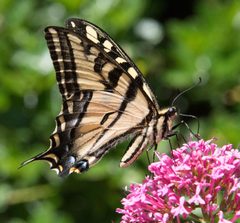
Papilio rutulus, the western tiger swallowtail, is a large, brightly colored native to western North America. First described by Hippolyte Lucas in 1852, this is frequently observed in urban parks, gardens, rural woodlands, and riparian areas. are active and rarely seen at rest, with a wingspan of 7 to 10 cm. The species exhibits seasonal in its pupal stage, producing green chrysalids in summer and dark brown chrysalids in winter.

Pronunciation
How to pronounce Papilio rutulus: /pəˈpɪlioʊ ˈruːtələs/
These audio files are automatically generated. While they are not always 100% accurate, they are a good starting point.
Identification
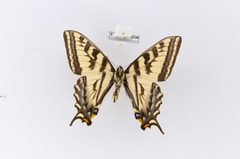
Distinguished from other tiger swallowtails by its western North American distribution. The combination of yellow wings with black tiger stripes, blue and orange spots near the hindwing tails, and large size separates it from similar . The two-tailed swallowtail (Papilio multicaudata) has more numerous and thinner black stripes on the forewings and two tails on each hindwing rather than one. The pale swallowtail (Papilio eurymedon) has pale yellow to cream-colored wings rather than bright yellow.
Images
Habitat
Frequently observed in urban parks and gardens, as well as rural woodlands and riparian areas. Associated with areas containing trees including cottonwood, willow, quaking aspen, and other deciduous .
Distribution
Native to western North America from southern British Columbia and Alberta, Canada, south to the southern tip of Baja California, Mexico. Extends eastward through the Dakotas, Colorado, and New Mexico, with rare strays recorded as far east as central Nebraska and Oklahoma.
Seasonality
emerge from chrysalids between February and May, with timing dependent on temperature and latitude. One to three per year depending on region, with earlier emergence in southern and coastal areas. Adults are active throughout the warmer months.
Diet
feed on nectar from flowers. Larvae feed on leaves of various deciduous trees; documented plants include cottonwood (Populus), willow (Salix), quaking aspen (Populus tremuloides), Prunus emarginata, Prunus virginiana var. demissa, and Salix lasiolepis. Host plant preference varies geographically.
Host Associations
- Populus - larval food plantcottonwood
- Salix - larval food plantwillow including Salix lasiolepis
- Populus tremuloides - larval food plantquaking aspen
- Prunus emarginata - larval food plantbitter cherry; larvae develop faster and have higher survival rates compared to Salix
- Prunus virginiana var. demissa - larval food plantwestern chokecherry; larvae reach largest final masses on this
Life Cycle
Females lay up to approximately 100 singly on undersides of plant leaves. Eggs are deep green, shiny, and spherical. Caterpillars emerge after about four days, feed on host leaves, and four times. Larvae construct silken mats in shelters of curled leaves for resting. occurs in a chrysalis; summer pupae emerge as in approximately 15 days, while fall pupae enter and overwinter, emerging the following spring. Developmental rate, survival, and final mass vary with host plant .
Behavior
are highly active and rarely seen at rest. Males congregate at pools, streams, and rivers to drink water and mud, extracting minerals and moisture—a known as puddling. Larvae display defensive behavior using the osmeterium, a tongue-like reversible gland that emits defensive compounds, combined with eyespots to mimic snakes and deter . Larvae occasionally engage in leaf-clipping behavior. Adults are smaller in colder climates, an to shorter growing seasons. Pupae can survive cold winters beneath snow through physiological processes that may involve cryoprotectants.
Ecological Role
function as while feeding on nectar. Larvae serve as herbivores on deciduous trees, with their performance and influenced by plant quality. The ' ability to utilize diverse host plants contributes to its success at higher latitudes compared to many tropical swallowtail species.
Human Relevance
Frequently observed and appreciated in urban parks and gardens, contributing to public engagement with nature. Popular subject for photography and artwork, including tattoos. Used as an educational specimen in entomology museums and outreach events. Subject of long-term monitoring studies in central California since 1972.
Similar Taxa
- Papilio multicaudataTwo-tailed swallowtail has more numerous and thinner black stripes on forewings and two tails per hindwing versus one
- Papilio eurymedonPale swallowtail has pale yellow to cream wings rather than bright yellow, and lacks the bold tiger striping
- Papilio appalachiensisAppalachian tiger swallowtail is an eastern with overlapping range only in limited areas; subtle wing pattern differences
More Details
Host plant quality effects
Research demonstrates that larval performance varies significantly with plant . Larvae develop faster on Prunus species than on Salix lasiolepis, with highest survival on Prunus emarginata and largest final masses on Prunus virginiana var. demissa.
Former classification
Previously classified in Pterourus along with other tiger swallowtails; modern classifications place all tiger swallowtails within Papilio.
Climate adaptation
Unlike many tropical swallowtail , P. rutulus can tolerate cold winters as diapausing pupae, enabling successful development at higher latitudes and elevations.
Sources and further reading
- BugGuide
- Wikipedia
- GBIF taxonomy match
- iNaturalist taxon
- NCBI Taxonomy
- Catalogue of Life
- Insect Art Is the 'In' Thing: Don't Miss Bohart Museum Open House on Jan. 21 | Bug Squad
- Art Shapiro: 'Butterflies as Heralds of the Apocalypse' | Bug Squad
- Yes, You Can Attend the 'Saving a Bug's Life' Symposium | Bug Squad
- Big Bioblitz Set April 29 at UC Davis: Plants, Animals and More | Bug Squad
- UC Davis Bee Garden Open House on May 12 | Bug Squad
- For the Love of Insects | Bug Squad
- Host Plant Mediated Differences in Papilio rutulus Lucas Larval Growth (Papilionidae)