
Papilio multicaudata
Kirby, 1884
Two-tailed Swallowtail
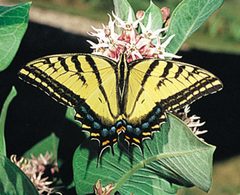
Papilio multicaudata, the two-tailed swallowtail, is a large in the Papilionidae found across western North America. It is distinguished from related tiger swallowtails by having two tails on each hindwing rather than one, and by the presence of a black 'slit pupil' in the orange eyespot on each hindwing. It is the largest swallowtail in western North America and serves as the state butterfly of Arizona. fly during spring and summer with one per year.

Pronunciation
How to pronounce Papilio multicaudata: /pəˈpɪlioʊ ˌmʌltiˈkɔːdəteɪ/
These audio files are automatically generated. While they are not always 100% accurate, they are a good starting point.
Identification
Distinguished from Papilio rutulus (western tiger swallowtail) and Papilio glaucus (eastern tiger swallowtail) by: (1) usually having two tails per hindwing rather than one, (2) narrower black stripes on wings, (3) presence of black 'slit pupil' in orange eyespot on hindwing (never present in P. rutulus), and (4) generally larger size. Females have wider black stripes on forewings than males. Does not tend to hybridize with related as do other tiger swallowtails.
Images
Habitat
Occurs near streams and in moist valleys, but also found in canyons and cities at lower elevations. Associated with riparian corridors and areas where plants grow.
Distribution
Western North America from southern British Columbia, Alberta, and southwestern Saskatchewan in Canada, south through the western United States (Washington, Oregon, California, Nevada, Arizona, New Mexico, Colorado, Texas) to Guatemala and Central America.
Seasonality
fly during spring and summer with one per year. Pupae overwinter and emerge in May.
Diet
feed on nectar from various flowers. Larvae feed on leaves of plants including chokecherry (Prunus virginiana), bitter cherry (Prunus emarginata), Arizona rosewood (Vauquelinia californica), single-leaf ash (Fraxinus anomala), hoptree (Ptelea trifoliata), and Arizona sycamore (Platanus wrightii). In California, primarily uses California hoptree (Ptelea crenulata). In other western urban areas, often uses green ash (Fraxinus pennsylvanica) planted along city roads.
Host Associations
- Prunus virginiana - larval food plantchokecherry
- Prunus emarginata - larval food plantbitter cherry
- Vauquelinia californica - larval food plantArizona rosewood
- Fraxinus anomala - larval food plantsingle-leaf ash
- Ptelea trifoliata - larval food planthoptree
- Platanus wrightii - larval food plantArizona sycamore
- Ptelea crenulata - larval food plantCalifornia hoptree; primary in California
- Fraxinus pennsylvanica - larval food plantgreen ash; commonly used in western cities outside California
Life Cycle
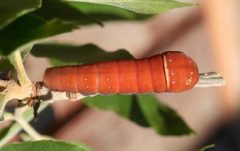
Females lay singly on plant leaves. Caterpillars fold host plant leaves and tie them together with silk, feeding from this protective structure. Pupae overwinter and emerge in May. One per year.
Behavior
Males engage in mud-puddling . are strong fliers. Caterpillars construct leaf shelters by folding and tying leaves with silk. The orange eyespots on hindwings may serve to deflect attacks toward the rear of the rather than the , providing an escape opportunity.
Ecological Role
Larval herbivore on various woody plants; . Serves as prey for various including birds and insects.
Human Relevance
State of Arizona. Popular among butterfly watchers and photographers. Occasionally encountered in urban and suburban gardens where plants are present.
Similar Taxa
- Papilio rutulusWestern tiger swallowtail; differs by having only one tail per hindwing, lacking the black 'slit pupil' in the orange eyespot, and having broader black stripes
- Papilio glaucusEastern tiger swallowtail; eastern counterpart with one tail per hindwing, no 'slit pupil' in eyespot, and generally smaller size (though some individuals match P. multicaudata in size)
- Papilio canadensisCanadian tiger swallowtail; northern with one tail per hindwing and no 'slit pupil'
More Details
Subspecies
Three recognized : P. m. multicaudata (widespread from southern Colorado and northern New Mexico south through Arizona, New Mexico, Texas and much of Mexico); P. m. pusillus (northern subspecies in Rockies from southern Colorado north to Canada, throughout Washington and Oregon, and south along Pacific Coast to at least Ventura County, California, as well as in Sierras and Great Basin); and P. m. grandiosus (Mexican mountains).
Conservation Status
Not considered threatened; widespread and relatively common throughout its range. Urban development and plant availability may limit in some areas.