
Papilio aristodemus
Esper, 1794
Schaus' swallowtail, island swallowtail
Species Guides
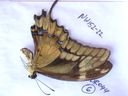
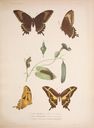
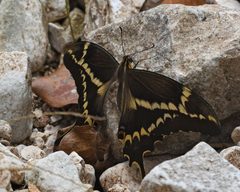
1Papilio aristodemus, commonly known as Schaus' swallowtail or island swallowtail, is a in the Papilionidae to southern Florida, the West Indies, and the Bahamas. It is one of North America's most endangered butterflies, with the Florida (P. a. ponceana, now Heraclides ponceana) listed as endangered since 1984. The produces a single annually with active primarily in May and June. loss from urban development, hurricanes, and mosquito control spraying has caused dramatic declines, including near-extinction from Hurricane Andrew in 1992.
Pronunciation
How to pronounce Papilio aristodemus: /pəˈpɪlioʊ ˌærɪstoʊˈdiːməs/
These audio files are automatically generated. While they are not always 100% accurate, they are a good starting point.
Identification
Distinguished from the giant swallowtail (Papilio cresphontes) by absence of the small red patch within the blue band on the underside of the hindwing. The rusty patch and specific yellow banding pattern on forewings are diagnostic. Sexes separable by coloration: males have black antennae with yellow terminal knob, females have uniformly black antennae.
Images
Habitat
Tropical hardwood hammocks in southern Florida and the West Indies. In Florida, historically occupied tropical hardwood hammock from South Miami to Lower Matecumbe Key, now restricted to Florida Keys islands. Prefers areas with dappled sunlight penetrating . In the Keys, occurs at relatively high elevation (3.0–4.6 m above sea level), avoiding tidal zones.
Distribution
United States: southern tip of Florida (currently restricted to Florida Keys, primarily Biscayne National Park islands and Key Largo). West Indies: Hispaniola (Dominican Republic and Haiti), Cuba, Cayman Islands, possibly Puerto Rico. Bahamas: Great Inagua, Crooked Island, Acklins Islands.
Seasonality
Single season with active primarily May–June; most sightings between mid-April and mid-July. Some adults observed in late July and early September. Adult triggered by rainfall. activity from approximately 7 am to 7 pm.
Diet
: nectar from guava (preferred source), cheese shrub, hibiscus, wild coffee; will travel considerable distances for blooming guava. Larvae: plants in Rutaceae including hoptree (Ptelea trifoliata), citrus , sea torchwood (Amyris elemifera), lime prickly-ash (Zanthoxylum fagara); wild lime (Zanthoxylum fagara) specifically mentioned for oviposition.
Life Cycle
Single per year (). laid April–June on wild lime; hatch in up to 10 days. Larvae mature in 3–4 weeks, reaching up to 76 mm. occurs in chrysalis; emerge following spring, triggered by rainfall. Some individuals remain in chrysalis for up to two years.
Behavior
Territorial; males patrol females and investigate intruding butterflies. Males patrol tree up to 3 m height on hot afternoons and linger in open areas seeking females. rapid and unpredictable, typically 1–2 m above ground. Highly maneuverable within hardwood hammocks, navigating branches and spider webs. Capable of sustained flight across open water; observed crossing 360 m between islands. Maximum daily movement documented at 9.3 km.
Ecological Role
; transfer pollen while nectaring. Larvae function as herbivores on Rutaceae vegetation. Serves as for tropical hardwood hammock health. Prey for birds, lizards, and spiders.
Human Relevance
Flagship for conservation of tropical hardwood hammock in Florida. Subject of intensive captive breeding program at University of Florida McGuire Center following near-extinction from Hurricane Andrew (1992). Florida (ponceana) federally listed as endangered in 1984. Named in honor of entomologist William Schaus.
Similar Taxa
- Papilio cresphontes (giant swallowtail)Overlapping range and similar size; distinguished by presence of small red patch within blue band on hindwing, which P. aristodemus lacks
- Heraclides ponceana (formerly P. a. ponceana)Florida elevated to status in 2020; now considered distinct , though historically treated as
More Details
Taxonomic changes
The Florida P. a. ponceana was elevated to status as Heraclides ponceana in 2020, with subgenus Heraclides elevated to . This is considered Critically Imperiled by NatureServe.
Conservation status
Following Hurricane Andrew in 1992, only 73 individuals survived in Florida. Captive breeding initiated in 1993; emergency measures in 2012 when found only 5 individuals. By 2014, over 1,000 larvae produced and released on Elliott Key.
Subspecies
Five recognized: P. a. aristodemus (Hispaniola, possibly Puerto Rico), P. a. bjordalae (Great Inagua), P. a. majasi (Crooked and Acklins Islands), P. a. ponceana (southern Florida, now Heraclides ponceana), P. a. temenes (Cuba, Cayman Islands).
Sources and further reading
- BugGuide
- Wikipedia
- GBIF taxonomy match
- NCBI Taxonomy
- Catalogue of Life
- Bird droppings, snake eyes, dead leaves: Swallowtails, Papilio spp. — Bug of the Week
- Papilionoidea | Blog
- Swallowtails where art thou? Swallowtail butterflies, Papilionidae — Bug of the Week
- Parsley poacher: Black swallowtail caterpillar, Papilio polyxenes — Bug of the Week
- Swallowtail soiree - Papilio glaucus — Bug of the Week
- Swallowtail soiree – Eastern tiger swallowtail, Papilio glaucus — Bug of the Week