
Neominois ridingsii
(Edwards, 1865)
Ridings' satyr
Neominois ridingsii is a North American in the Nymphalidae, commonly known as Ridings' satyr. The occupies short-grass prairie and intermountain grassland across a broad range from southern Canada to the southwestern United States. Larvae feed exclusively on Bouteloua gracilis, and third- and fourth-instar larvae overwinter. Multiple have been described based on geographic variation across its range.
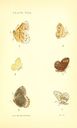
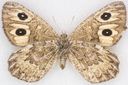
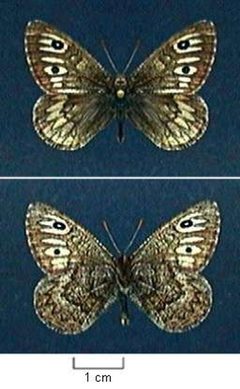
Pronunciation
How to pronounce Neominois ridingsii: /niːˈɒmɪnɔɪs ˌrɪˈdɪŋzi.aɪ/
These audio files are automatically generated. While they are not always 100% accurate, they are a good starting point.
Images
Habitat
Short-grass prairie, intermountain areas, and grasslands with patches of bare soil. Occupies open, dry environments where the larval plant Bouteloua gracilis occurs.
Distribution
Southern Alberta, Saskatchewan, and Manitoba in Canada south to Guadalupe and Catron counties of New Mexico, and west to the central Sierra Nevada of California and central Oregon.
Diet
Larvae feed on Bouteloua gracilis (blue grama grass). diet not documented.
Host Associations
- Bouteloua gracilis - larval plantExclusive larval food source
Life Cycle
Third- and fourth-instar larvae overwinter. Complete details otherwise undocumented.
Human Relevance
Named after James Ridings. No documented economic or conservation significance.
Similar Taxa
- Neominois carmenCongeneric with overlapping range; distinguished by wing pattern and preferences
- Satyrium speciesSimilar size and coloration in some ; Satyrium are hairstreaks with different wing shape and antennal clubs
More Details
Subspecies
Eight recognized: N. r. ridingsii, N. r. coloalbiterra, N. r. curicata, N. r. minimus, N. r. neomexicanus, N. r. pallidus, N. r. stretchii, and N. r. wyomingo. Subspecies primarily distinguished by geographic distribution and subtle morphological differences.
Etymology
Specific epithet ridingsii honors James Ridings.