
Phyciodes orseis
Edwards, 1871
California Crescent, Orseis crescentspot
Phyciodes orseis is a small nymphalid to western North America, with its core range in northern California and Oregon. It inhabits mountain valleys, meadows, and stream canyons, where it has been documented as part of monitoring efforts on the Fremont-Winema National Forests. The has experienced range contraction, with historical records from the San Francisco Bay Area now considered mislabeled or representing extirpated .
Pronunciation
How to pronounce Phyciodes orseis: /faɪˈsaɪəˌdiːz ˈɔːrsiˌɪs/
These audio files are automatically generated. While they are not always 100% accurate, they are a good starting point.
Identification
Similar to other Phyciodes crescents, particularly P. mylitta (Mylitta Crescent) and P. campestris (Field Crescent). Distinguished by geographic range: P. orseis occurs primarily in northern California and Oregon, whereas P. mylitta is more widespread and abundant in disturbed . P. campestris has declined in low-elevation California sites and differs in habitat preference. Subspecific identification requires examination of genitalia or detailed pattern analysis.
Images
Appearance
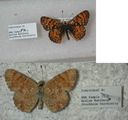
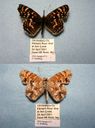
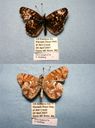
Wingspan 32–42 mm. wing surfaces orange with black markings, typical of the Phyciodes. hindwing with characteristic crescent-shaped silver markings. White fringes border the wing edges.
Habitat
Mountain valleys, meadows, and stream canyons. Associated with montane and foothill environments in the Coast Range and Cascade-Sierra transition zone.
Distribution
Western North America, primarily northern California and Oregon. Core in the Coast Range of northern California and southwestern Oregon. Historical records suggested range extension to San Francisco, but these are now considered erroneous or represent extirpated populations. Documented in Lake and Klamath counties, Oregon, through Forest Service monitoring.
Seasonality
. period mid-May to late June annually.
Diet
feed on nectar. Larvae feed on plants of Cirsium ( Asteraceae).
Host Associations
- Cirsium - larval plant laid in large clusters on Cirsium
Life Cycle
laid in large clusters on plants. Larvae hatch and develop to third instar, then enter and overwinter. Development resumes the following spring. and occur in late spring.
Behavior
patrol areas during season. Males may perch at ground level, as observed in .
Ecological Role
of regional flora. Serves as food source for avian . Used as a monitoring metric for health on managed forest lands.
Human Relevance
Included in Forest Service monitoring programs as an for native health. trends contribute to assessments of status in the Fremont-Winema National Forests.
Similar Taxa
- Phyciodes mylittaSimilar orange and black coloration with crescent markings. P. mylitta is more abundant, uses weedy thistle , and occupies broader range including urban and disturbed .
- Phyciodes campestrisFormerly sympatric in some California areas. P. campestris has undergone regional extinction from low-elevation sites and differs in and specificity.
- Phyciodes tharosEastern North American with similar appearance. distribution prevents confusion in the field.
Misconceptions
Formerly believed to range south to San Francisco; these records are now attributed to misidentification or represent no longer present.
More Details
Subspecies
P. o. orseis (nominate ); P. o. herlani Bauer, 1975 (California, Nevada: Douglas Co.)
Sources and further reading
- BugGuide
- Wikipedia
- GBIF taxonomy match
- iNaturalist taxon
- NCBI Taxonomy
- Catalogue of Life
- Art Shapiro: 'Using Butterflies to Understand Biotic Responses to Climate Change' | Bug Squad
- Where Are All the Butterflies? | Bug Squad
- Mylitta Crescent: Thistle Lover | Bug Squad
- Bug Squad
- Stylish Lepidoptera: Ermine Moth, Atteva aurea; Yellow-Collared Scape Moth, Cisseps fulvicollis; Pearl Crescent, Phyciodes tharos; Variegated Fritillary, Euptoieta claudia — Bug of the Week
- Bug Eric: City Nature Challenge 2023 Recap
- Early stage and biology of Phyciodes orseis