
Chlosyne nycteis
(Doubleday)
Silvery Checkerspot
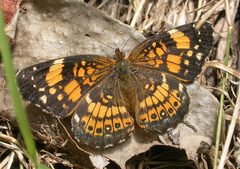
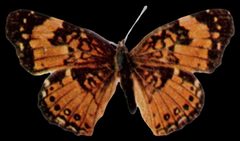
Chlosyne nycteis, the silvery checkerspot, is a North American in the Nymphalidae. display pale yellow-orange wings with dark borders and distinctive white-centered submarginal spots on the hindwings. The inhabits moist areas including streamsides, meadows, and forest openings across a broad range from southern Canada to Georgia, Florida, and Texas. It has declined in parts of its northeastern range and is listed as a species of special concern in Connecticut and Maine, believed extirpated from Connecticut, Massachusetts, and New Hampshire.
Pronunciation
How to pronounce Chlosyne nycteis: //kloʊˈsaɪni ˈnɪktɪs//
These audio files are automatically generated. While they are not always 100% accurate, they are a good starting point.
Identification
Distinguished from similar checkerspot by the white-centered submarginal spots on the hindwing, present on both upper and lower surfaces. The pale yellow-orange ground color and white marginal crescent on the hindwing also aid identification. Compare with other Chlosyne species which may lack the distinct white-centered spots or have different color patterns.
Images
Habitat
Moist environments including streamsides, wet meadows, and forest openings. Also found in drier meadow adjacent to woodland. plant availability (various Asteraceae) influences local distribution.
Distribution
North America: southern Canada (Manitoba, Saskatchewan) south through the eastern and central United States to Georgia, Florida, and Texas. Western limit approximately Texas; eastern distribution extends through New England though have declined or been extirpated in parts of this region.
Seasonality
Northern portion of range: one , June to July. Remainder of range: two broods, May to September. Deep southern Texas: three broods reported. active during daylight hours.
Diet
Larva: various Asteraceae including Eurybia macrophylla (large-leaved aster), Verbesina alternifolia (wingstem), Helianthus (sunflowers), and Rudbeckia (coneflowers). : nectar from flowers including Trifolium pratense (red clover), Asclepias syriaca (common milkweed), and Apocynum (dogbane).
Host Associations
- Eurybia macrophylla - larval food plantLarge-leaved aster
- Verbesina alternifolia - larval food plantWingstem
- Helianthus - larval food plantSunflower
- Rudbeckia - larval food plantConeflower
- Trifolium pratense - nectar sourceRed clover
- Asclepias syriaca - nectar sourceCommon milkweed
- Apocynum - nectar sourceDogbane
Life Cycle
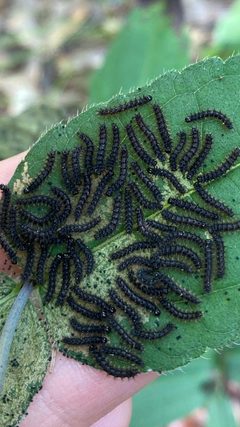
Females lay in batches up to 100 individuals. Early instar caterpillars feed gregariously, skeletonizing leaves. Third instar caterpillars hibernate, completing development the following spring. occurs in spring or early summer depending on number. One to three per year depending on latitude.
Behavior
Early instar larvae feed in groups, skeletonizing leaves of plants. visit flowers for nectar. Males likely patrol for females though specific mating not well documented in sources.
Ecological Role
Larval herbivore on native Asteraceae. . Part of supporting and . declines in northeastern states suggest sensitivity to alteration or other environmental changes.
Human Relevance
Subject of conservation concern in northeastern United States due to declines and apparent extirpations. Listed as of special concern in Connecticut and Maine. Potential for healthy meadow and wetland edge . Occasionally observed by watchers and naturalists.
Similar Taxa
- Chlosyne laciniaBordered patch ; similar checkerspot pattern but lacks white-centered submarginal spots on hindwing; more western and southern distribution with some range overlap in Texas
- Other Chlosyne speciesShare checkerspot wing pattern but differ in spot details, color intensity, and marginal markings; precise identification requires examination of hindwing submarginal spot characteristics
More Details
Conservation Status
Listed as of special concern in Connecticut and Maine. Believed extirpated from Connecticut, Massachusetts, and New Hampshire. declines in northeastern portion of range contrast with apparently stable populations in core of range. Causes of decline not definitively established but may include loss, deer browse reducing plant availability, or climate-related factors.
Taxonomic Note
Formerly placed in Melitaea as Melitaea nycteis. Transferred to Chlosyne based on phylogenetic studies of Nymphalidae. Member of tribe Melitaeini, a group of checkerspot butterflies characterized by reduced forelegs and distinctive larval spination.