
Chlosyne lacinia
(Geyer, 1837)
Bordered Patch, Sunflower Patch
Chlosyne , commonly known as the bordered patch or sunflower patch, is a highly variable nymphalid native to North and South America. display extensive color in both wing pattern and ground color, with individuals ranging from predominantly black to those with prominent orange, red, or yellow markings. The exhibits gregarious larval , with females depositing in large clusters and young larvae feeding communally before becoming solitary in later instars. It is a herbivore with strong associations to Asteraceae, particularly sunflowers (Helianthus), and has been documented as an agricultural pest in some regions.
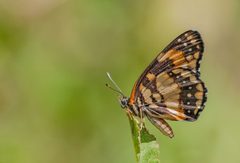
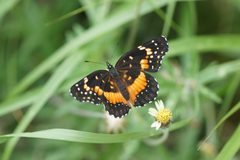
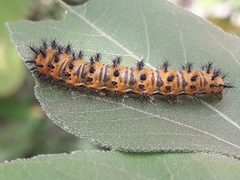
Pronunciation
How to pronounce Chlosyne lacinia: /kloʊˈsaɪni ə ˈlæʃɪniə/
These audio files are automatically generated. While they are not always 100% accurate, they are a good starting point.
Identification
The bordered patch is distinguished from similar Chlosyne by the following characters: crimson patch (Chlosyne janais) is larger, has two spots in the forewing (versus one), and the underside of the hindwing has a yellow basal patch with black spots; rosita patch (Chlosyne rosita) has a two-toned basal patch on the upperside of the hindwing and the underside is mostly pale yellow with a thick black marginal border; red-spotted patch (Chlosyne marina) has a row of red marginal spots on the upperside and distinctive red spotting on the underside of the hindwing. The extreme variability of C. can make identification challenging; the combination of small size, single forewing cell spot, and presence of a red tornal spot on the hindwing underside is diagnostic.
Images
Appearance
are small to medium-sized butterflies with wingspan 32–48 mm. The upperside is predominantly black with highly variable spotting: forewings bear rows of white and/or yellow-orange spots of variable size, usually with one whitish spot in the . Hindwing coloration ranges from nearly all black to having red postmedian spots, rows of white postmedian spots, an all red-orange discal area, or a yellow-orange postmedian band of varying width. The underside is equally variable, ranging from rows of white and red spots to a yellow-white band on the hindwing, or mostly golden yellow with large yellow-orange spots and a thick golden-yellow median band. All variations possess a red spot near the hindwing tornus. Larvae are also polymorphic, ranging from mostly orange with black spines and stripes to black with a red-orange mid- stripe to nearly all black, with all forms having a red-orange . Pupae vary from almost all white to white with black markings to nearly all black.
Habitat
In the United States, occurs in desert hills, mesquite woodlands, pinyon woodlands, and oak woodlands. Strongly associated with agricultural areas and weedy wastelands where plants, particularly Helianthus annuus, are abundant. In Central America (Belize, Rica, Panama), found in roadside verges, unmowed rows between citrus plantations, and other disturbed ground areas where Asteraceae, Acanthaceae, and Amaranthaceae provide nectar and larval host resources. Also documented in dune with desert shrubs and wildflowers, and in wetland margins with milkweed stands.
Distribution
Native to North and South America. In North America, ranges from the southwestern United States (California, Arizona, Texas, New Mexico) south through Mexico and Central America to South America. Documented from Colombia (Manizales, Montería, Yopal, Villavicencio, and multiple river basin localities). Present year-round in southern Texas; seasonal farther north with periods varying by latitude and elevation.
Seasonality
period varies geographically: May to October in California; late January to mid-November in Arizona; year-round in southern Texas. Multiple per year (three to four ) in most of range. Third instar larvae undergo both hibernation and estivation, contributing to extended flight season in some areas.
Diet
Larvae are herbivores feeding primarily on Asteraceae. Documented plants include: Helianthus annuus (common sunflower), Helianthus argophyllus (silverleaf sunflower), Helianthus ciliaris (Texas blueweed), Helianthus debilis (cucumberleaf sunflower), Helianthus maximiliani (Maximilian sunflower), Helianthus tuberosus (Jerusalem artichoke), Ambrosia artemisiifolia (common ragweed), Ambrosia trifida var. texana (giant ragweed), Gaillardia pulchella (Indian blanketflower), Calyptocarpus vialis (straggler daisy), Verbesina encelioides (crown-beard), Xanthium pennsylvanicum, Zexmenia hispida (orange zexmenia), Parthenium hysterophorus (Santa Maria feverfew), Heterotheca latifolia (camphor weed), Palafoxia sphacelata (showy palafox), Eupatorium , and Baltimora species. Also documented on Tithonia diversifolia and Tithonia tubaeformis (Cuban grass). feed on nectar from various flowers including milkweeds (Asclepias) and composites.
Host Associations
- Helianthus annuus - larval preferred ; agricultural pest association
- Helianthus argophyllus - larval
- Helianthus ciliaris - larval
- Helianthus debilis - larval
- Helianthus maximiliani - larval
- Helianthus tuberosus - larval
- Ambrosia artemisiifolia - larval
- Ambrosia trifida var. texana - larval
- Gaillardia pulchella - larval
- Tithonia diversifolia - larval supports complete development to
- Tithonia tubaeformis - larval confirmed alternative ; 48-day completed
- Asclepias spp. - nectar source
Life Cycle
Complete with , larva (six instars), pupa, and stages. Females deposit eggs in clusters of approximately 100 or more on the underside of plant leaves. Eggs are pale yellow-green initially, turning reddish later. approximately 8 days under laboratory conditions. Young larvae feed gregariously; do not construct nests. Larvae become solitary in later instars. Larval period averages 25 days (range 24.9 days in laboratory studies). Third instar larvae undergo , serving as the hibernating and estivating stage. Pupal period approximately 7 days (6.9 days laboratory). Adult lifespan approximately 8 days. Total duration approximately 48 days under controlled laboratory conditions on Tithonia tubaeformis. Three to four per year in most of range. Sex ratio slightly female-biased (1.1:1); female pupae heavier than males. Survival from egg to pupa approximately 52% in laboratory conditions; individual stage survival rates exceed 70%.
Behavior
exhibit , with males awaiting females on hilltops for mating. Females perform drumming behavior with foretarsi and antennal dipping prior to oviposition, using contact on foretarsi for verification when olfactory cues are unreliable. Antennal receptors are important for oviposition initiation; antennal ablation reduces oviposition proportionally to number of receptors removed. Larvae are gregarious in early instars, feeding in groups that enhance feeding on tough host leaves and improve survival. Group feeding enables early-instar larvae to initiate feeding wounds on tough sunflower leaves that individual larvae cannot penetrate. Larvae possess aposematic coloration but group defenses are ineffective against mass-attacking predatory ants (Solenopsis xyloni). Pupae exhibit phenotypic plasticity in coloration: rearing on dark substrates produces more heavily melanized pupae, suggesting as an adaptive function; darker pupae have longer developmental periods, indicating a trade-off between defensive coloration and development time.
Ecological Role
Herbivore in terrestrial , primarily consuming Asteraceae. Larval feeding can cause significant defoliation of plants, occasionally reaching pest status in agricultural sunflower crops. Serves as prey for various guilds including ground-dwelling arthropods (particularly fire ants), aerial arthropods, and avian predators, though group living and aposematism provide partial protection against solitary predators. pollination services through nectar feeding. Contributes to nutrient cycling through herbivory and production.
Human Relevance
Occasional agricultural pest on cultivated sunflowers and related crops, with potential for significant defoliation. Subject of scientific research on insect-plant chemical , larval , sensory physiology of selection, and phenotypic plasticity. Popular subject for observation and photography due to abundance in disturbed and striking color variability. No significant direct medical or veterinary importance.
Similar Taxa
- Chlosyne janaisCrimson patch; larger size, two forewing spots (versus one), yellow basal patch with black spots on hindwing underside
- Chlosyne rositaRosita patch; two-toned basal patch on hindwing upperside, pale yellow hindwing underside with thick black marginal border
- Chlosyne marinaRed-spotted patch; row of red marginal spots on upperside, distinctive red spotting on hindwing underside
More Details
Sensory Physiology
Foretarsal contact detected via electrophysiological techniques; used for verification during drumming when environmental conditions reduce reliability of olfactory cues (e.g., cool leaf temperatures, air turbulence).
Chemical Ecology
Larvae can tolerate and excrete intact sesquiterpene lactones (furanoheliangolide-type) from plants, suggesting evolved mechanisms. Flavonoid glycosylation is the primary mechanism for consumed flavonoids. Lysophospholipids are important metabolites during pupal and stages.
Phenotypic Plasticity
Extreme variability in wing patterns and colors, larval coloration, and pupal coloration represents one of the most polymorphic in North America. Substrate color during pupal development influences melanization through phenotypic plasticity rather than genetic .
Sources and further reading
- BugGuide
- Wikipedia
- GBIF taxonomy match
- iNaturalist taxon
- NCBI Taxonomy
- Catalogue of Life
- Bug Eric: Bosque del Apache National Wildlife Refuge
- Bug Eric: January 2016
- 2018 Arizona Insect Collecting Trip “iReport” | Beetles In The Bush
- The consequences of larval aggregation in the butterfly Chlosyne lacinia
- Foodplant ecology of the butterfly Chlosyne lacinia (Geyer) (Nymphalidae) III. Adult resources
- Foodplant ecology of the butterfly Chlosyne lacinia (Geyer) Nymphalidae; II. Additional larval food plant data
- The External Morphology of Foretarsal Receptors Involved with Host Discrimination by the Nymphalid Butterfly, Chlosyne lacinia
- Natural Products Diversity in Plant-Insect Interaction between Tithonia diversifolia (Asteraceae) and Chlosyne lacinia (Nymphalidae)
- Life cycle of Chlosyne lacinia saundersii (Lepidoptera: Nymphalidae) on Tithonia tubaeformis (Jacq.) Cass. under controlled laboratory conditions
- THE ROLE OF SENSORY STRUCTURES AND PREOVIPOSITION BEHAVIOR IN OVIPOSITION BY THE PATCH BUTTERFLY, CHLOSYNE LACINIA
- A Comprehensive Natural History Review of Chlosyne lacinia (Geyer, 1837; Lepidoptera: Nymphalidae): Patterns of Phenotypic Variation and Geographic Distribution
- Identifying the proximal cue(s) for pupal color variation in the bordered patch butterfly, Chlosyne lacinia (Lepidoptera: Nymphalidae)
- The effects of foliar spray application of silicon on plant damage levels and components of larval biology of the pest butterflyChlosyne lacinia saundersii(Nymphalidae)
- Dynamics of Redox Metabolism during Complete Metamorphosis of Insects: Insights from the Sunflower Caterpillar Chlosyne lacinia (Lepidoptera).