
Melinaea lilis
(Doubleday, 1847)
Mimic Tigerwing
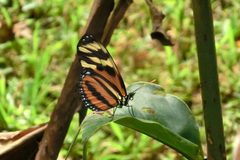
Melinaea lilis is a in the Nymphalidae, commonly known as the Mimic Tigerwing. It belongs to the tribe Ithomiini, a group of neotropical butterflies known for their unpalatability to and participation in Müllerian mimicry rings. The was originally described as Mechanitis lilis by Doubleday in 1847. It is one of approximately 12 species in the Melinaea, which are distributed across Central and South America.
Pronunciation
How to pronounce Melinaea lilis: /mɛ.lɪˈnaɪ.iə ˈlaɪ.lɪs/
These audio files are automatically generated. While they are not always 100% accurate, they are a good starting point.
Identification
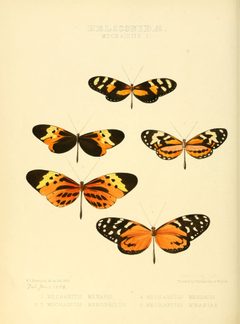
Melinaea lilis can be distinguished from by wing pattern elements, though specific diagnostic features require examination of forewing and hindwing markings. The Melinaea is characterized by medium-sized butterflies with elongated forewings and translucent patches on the wings. within Melinaea are often distinguished by the arrangement and shape of orange, black, and white markings, as well as the extent of hyaline (clear) areas on the wings. Accurate identification to species level often requires reference to geographic location and comparison with closely related species such as Melinaea marsaeus and Melinaea menophilus.
Images
Habitat
Inhabits tropical and subtropical forested environments, including lowland rainforests and premontane forests. Occurs in areas with adequate cover and presence of larval plants in the Solanaceae.
Distribution
Found in Central America and northern South America. Documented from Rica through Panama, and into Colombia, Venezuela, and Ecuador. Distribution extends across the Caribbean slope of Central America and into the Amazonian region of South America.
Seasonality
are active year-round in suitable tropical , with peak abundance varying by locality and influenced by rainfall patterns. No distinct migratory has been documented.
Diet
feed on nectar from flowers and obtain additional nutrients from decomposing organic matter, including rotting fruit and animal droppings. Larvae feed on plants in the Solanaceae, though specific plant records for M. lilis are limited.
Host Associations
- Solanaceae - larval plant Specific plant for M. lilis not well documented; related Melinaea have been reared on Solanum and other solanaceous plants
Life Cycle
Complete with four stages: , larva, pupa, and . Larvae are cylindrical with fleshy projections and feed solitarily on plant leaves. occurs on the host plant or nearby vegetation. Developmental duration varies with temperature and host plant quality. Adults are relatively long-lived compared to many butterflies, facilitated by their chemical protection from .
Behavior
fly slowly with a gliding motion characteristic of the Ithomiini. Males engage in patrolling to locate females. Both sexes are active throughout the day, with peak activity in mid-morning and afternoon. Adults roost in on vegetation, sometimes in mixed- groups with other unpalatable butterflies.
Ecological Role
Participates in Müllerian mimicry complexes with other unpalatable butterflies, including in the Mechanitis, Tithorea, and others. This mutualistic relationship reinforces avoidance learning. As larvae, they function as herbivores on Solanaceae. contribute to pollination through nectar feeding, though their ecological impact as is not well quantified.
Human Relevance
Of interest to collectors and ecotourists due to its distinctive appearance. Serves as a subject for research on chemical , mimicry, and butterfly-plant interactions. Not considered an agricultural pest.
Similar Taxa
- Mechanitis polymniaShares similar orange and black wing pattern and participates in the same Müllerian mimicry ring; differs in wing shape and specific arrangement of hyaline patches
- Melinaea marsaeus with overlapping distribution; distinguished by differences in forewing pattern and extent of white markings
- Tithorea harmoniaAnother ithomiine with similar coloration; larger size and different wing venation distinguish it from M. lilis
More Details
Chemical defense
Like other Ithomiini, larvae and sequester from plants, making them unpalatable to . This chemical protection is the basis for their participation in Müllerian mimicry rings.
Taxonomic history
Originally described in the Mechanitis by Doubleday in 1847, later transferred to Melinaea based on morphological and phylogenetic studies. The genus Melinaea has undergone taxonomic revision, with some former elevated to rank.