
Melinaea
Hübner, 1816
clearwing butterflies
Species Guides
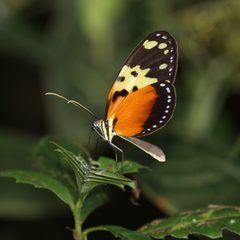
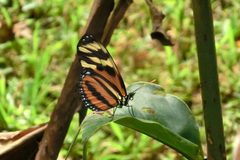
1- Melinaea lilis(Mimic Tigerwing)
Melinaea is a of clearwing (ithomiine) butterflies in the Nymphalidae, comprising 14 recognized . It is the most species-rich and widespread genus within the subtribe Melinaeina, distributed from Mexico to Northern Argentina. are aposematic and serve as main models in Neotropical Müllerian mimicry rings. The genus has been studied for its role in understanding speciation through divergent selection on wing colour patterns and the evolution of assortative mating.

Pronunciation
How to pronounce Melinaea: //ˌmɛlɪˈnaɪə//
These audio files are automatically generated. While they are not always 100% accurate, they are a good starting point.
Identification
Distinguished from other Ithomiini by combination of large size, clearwing with specific pattern elements, and subtribe Melinaeina characteristics. -level identification requires examination of wing colour pattern details, particularly the arrangement of orange, brown, and black markings on transparent wings. Males possess androconial on hindwings for . Genetic analysis may be necessary for definitive identification of closely related such as M. menophilus and M. marsaeus pairs.
Images
Habitat
Tropical and subtropical forests; Atlantic Forest of Brazil for M. mnasias thera; well-preserved forest in southern Bahia state for remaining of this . Distribution spans lowland to mid-elevation Neotropical forests.
Distribution
Mexico to Northern Argentina; Atlantic Forest of Brazil; north-eastern Peru. Most widespread within subtribe Melinaeina.
Behavior
active during daylight hours. Strong premating isolation observed between closely related M. satevis and M. marsaeus. Assortative mating evolved in M. marsaeus, where subspecific hybrids display intermediate, non-mimetic colour patterns subject to selection against maladaptive phenotypes. Males possess pheromonal differentiation between in M. marsaeus. Adults participate in Müllerian mimicry rings as model species.
Ecological Role
Main model in Neotropical Müllerian mimicry rings; aposematic warning of unpalatability, thereby protecting co-mimics. Role in pollination not documented.
Human Relevance
Subject of research on speciation mechanisms, divergent selection, and evolution of reproductive isolation. M. mnasias thera identified as conservation priority due to extreme rarity with fewer than 20 specimens known in world collections and potential restriction to well-preserved Atlantic Forest fragments in southern Bahia state.
Similar Taxa
- Other Melinaeina genera (Olyras, Paititia, Eutresis, Athyrtis)Sister within subtribe Melinaeina; distinguished by phylogenetic relationships and specific wing pattern configurations; Melinaea is most -rich and widespread
- Other Ithomiini generaShare clearwing and aposematism; distinguished by subtribe-level characteristics and specific pattern elements; Melinaeina represents sister group to all remaining Ithomiini
More Details
Systematic position
Subtribe Melinaeina is sister group to all remaining groups in tribe Ithomiini. Phylogenetic analysis recovers Melinaeina organized in two clades: Olyras + Paititia, and Eutresis + (Athyrtis + Melinaea).
Speciation research
Colour pattern divergence alone is insufficient for reproductive isolation; evolution of assortative mating appears driven by selection against maladaptive intermediate phenotypes in hybrids.
Sources and further reading
- BugGuide
- Wikipedia
- GBIF taxonomy match
- iNaturalist taxon
- NCBI Taxonomy
- Catalogue of Life
- Systematic position and conservation aspects of Melinaea mnasias thera (Lepidoptera: Nymphalidae: Danainae)
- Ecology, life history, and genetic differentiation in NeotropicalMelinaea(Nymphalidae: Ithomiini) butterflies from north-eastern Peru
- Does divergent selection predict the evolution of mate preference and reproductive isolation in the tropical butterfly genus Melinaea (Nymphalidae: Ithomiini)?