
Doxocopa pavon
(Latreille, 1809)
Pavon Emperor, Pavon
Doxocopa pavon is a sexually dimorphic in the emperor butterfly Apaturinae, with males displaying iridescent blue-purple upper wing surfaces and females exhibiting mimicry of unrelated Adelpha . The species ranges from South America through Mexico, with occasional vagrancy into southern Texas. Larvae feed exclusively on hackberry species (Celtis), while are nectar-feeders that also engage in mud-puddling and rotting material feeding.

Pronunciation
How to pronounce Doxocopa pavon: //ˌdɒksəˈkoʊpə ˈpævɒn//
These audio files are automatically generated. While they are not always 100% accurate, they are a good starting point.
Identification
Distinguished from Doxocopa laure (Silver Emperor) by pale brown (not silvery) wing undersides and smaller, less extended orange forewing patch; males lack squarish forewing tips of D. laure. Distinguished from Adelpha (sisters) by continuous white band that does not reach forewing (vs. broken into spots in A. bredowii, A. californica, A. eulalia) and absence of white on forewing costa (present in A. fessonia).
Images
Appearance
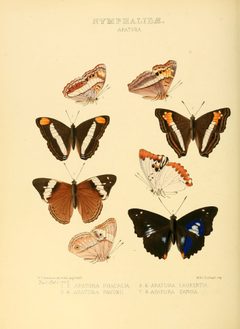
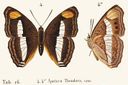
Wingspan 5.6–6.9 cm. Sexually dimorphic. Males: upper wing surfaces predominantly brown with vivid iridescent blue-purple sheen; white band barely visible on both forewings and hindwings; small orange patch at forewing tip; undersides pale brown. Females: upper surfaces brown without iridescence; broad, distinct white median band on forewings and hindwings that does not reach forewing costal margin; small orange forewing patch. Both sexes lack pointed hindwing tips present in .
Habitat
Tropical and subtropical forests including rainforests, at elevations of 200–1,000 m. D. p. theodora occupies Mexico, Central America, and Caribbean.
Distribution
Primary range: Bolivia and Paraguay northward through South America to northern Mexico. Vagrant to lower Rio Grande Valley, Texas, USA. D. p. theodora: Mexico, Central America, Caribbean.
Diet
Larvae feed on leaves of hackberries (Celtis spp.): Celtis pallida in the United States, Celtis iguanaea in Mexico. feed on nectar from Cordia and Croton flowers; also observed at rotting fruit, carrion, bird droppings, and mud-puddling on moist mineral-laden substrates.
Host Associations
- Celtis pallida - larval food plantDesert hackberry, primary in United States
- Celtis iguanaea - larval food plantIguana hackberry, in Mexico
Life Cycle
stage not described in sources. Larva: green with yellow-white lateral dots, indistinct yellow-white blotches, body tapering to pointed tail; green with black and ; two white and black stripes on extending to long forward-projecting green horns with forked black tips. Pupa: greenish, strongly arched, laterally flattened, with abdominal ridges; camouflaged as leaf. : sexually dimorphic, males perch in sunlight awaiting females.
Behavior
Males perch on trees in full sunlight, especially at midday, to await females. Females rarely observed, spending most time in forest . engage in mud-puddling on moist mineral-laden soil or rock. Both sexes visit rotting fruit, carrion, and bird droppings.
Ecological Role
serve as of Cordia and Croton. Larvae are herbivores on Celtis. Females participate in mimicry complex with unpalatable Adelpha , potentially gaining protection through .
Human Relevance
Subject to low-level collection pressure in Guatemala (averaging three specimens monthly), leading to listing on national wildlife red list. Occasionally observed by enthusiasts in southern Texas vagrant range. Global conservation status: secure (G5).
Similar Taxa
- Doxocopa laureSimilar size and coloration; distinguished by silvery (not pale brown) wing undersides, pointed hindwing tips, and males with squarish forewing tips and larger orange patch
- Adelpha fessoniaFemale D. pavon mimics this ; distinguished by white band reaching forewing in A. fessonia versus not reaching costa in D. pavon
- Adelpha bredowiiFemale D. pavon mimics this ; distinguished by white band broken into spots on forewing in A. bredowii versus continuous band in D. pavon
- Adelpha californicaFemale D. pavon mimics this ; distinguished by broken white band on forewing in A. californica
- Adelpha eulaliaFemale D. pavon mimics this ; distinguished by broken white band on forewing in A. eulalia
More Details
Mimicry complex
Females closely resemble multiple Adelpha (band-celled sister, pointed sister, Celerio sister, Bredow's sister, Arizona sister, California sister), suggesting participation in a large mimicry complex where some Adelpha species are unpalatable to .
Taxonomic history
Originally described as Nymphalis pavon by Latreille in 1809 from Loja, Ecuador. D. p. theodora described by Lucas in 1857 from Cuba, later also described under multiple invalid names by Boisduval, Fruhstorfer, and Röber.
Sources and further reading
- BugGuide
- Wikipedia
- GBIF taxonomy match
- iNaturalist taxon
- NCBI Taxonomy
- Catalogue of Life
- The Giants of the Reef: New Citizen Science Project Races to Document Centennial Corals | Blog
- “Oscar describes Oscar”: Interview with Oscar Lasso-Alcalá, Pt 3 | Blog
- So, how big do insects get? - Buglife Blog - Buglife