
Apaturinae
emperors
Tribe Guides
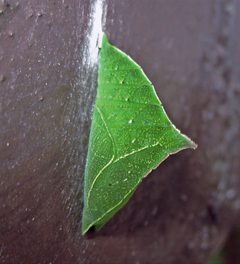
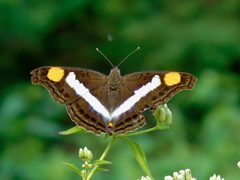
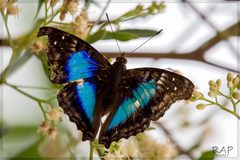
1Apaturinae is a of brush-footed butterflies (Nymphalidae) comprising approximately 20 and roughly 100 commonly called 'emperors.' Members are distinguished by a green , strikingly colored upperwings, and cryptic underwings. The subfamily exhibits a disjunct global distribution, with most genera occurring in South and East Asia and Africa, while the genera Doxocopa and Asterocampa are primarily Neotropical and Nearctic. Larvae of at least some species possess a unique defensive mechanism: oral emission of volatile halitosis (alcohols and aldehydes/ketones with 4–5 carbon chains) when disturbed by .
Pronunciation
How to pronounce Apaturinae: /əˌpætjʊˈraɪniː/
These audio files are automatically generated. While they are not always 100% accurate, they are a good starting point.
Identification
The green separates Apaturinae from all other Nymphalidae . Within the subfamily, can be distinguished by wing pattern and geographic distribution: Asterocampa and Doxocopa (Americas) typically have orange-brown upperwings with dark marginal bands; Apatura (Eurasia) often shows purple or brown iridescence with white bands; Sasakia and Hestina (East Asia) are among the largest with bold orange and black patterning. -level identification requires examination of wing pattern details, genitalia, and geographic range.
Images
Habitat
vary by and region. Asian and African genera occupy broadleaf forests, forest edges, and riparian corridors. Asterocampa are strongly associated with river bottoms and floodplain forests where hackberries (Celtis) occur. Some species inhabit warm broadleaf forests at moderate elevations. The as a whole shows preference for wooded habitats with access to larval host plants.
Distribution
Disjunct distribution with two major centers: (1) South and East Asia and Africa, where most occur including Apatura, Apaturina, Apaturopsis, Chitoria, Dilipa, Euapatura, Eulaceura, Euripus, Helcyra, Herona, Hestina, Hestinalis, Mimathyma, Rohana, Sasakia, Sephisa, Thaleropis, and Timelaea; and (2) the Americas, where Doxocopa occurs primarily in South America and Asterocampa in North and Central America. have been documented from the Korean Peninsula, Japan, China, Southeast Asia, India, Africa, and North America.
Seasonality
fly during warm months; specific timing varies by latitude and . In temperate regions, periods typically span late spring through summer. Some species with multiple may be present from spring through fall. Observations in Bhutan indicate July–October activity for Chitoria sordida.
Diet
feed on nectar, sap flows, rotting fruit, and animal . Larvae are folivorous, feeding primarily on leaves of Celtis (hackberry/sugarberry, Cannabaceae) and related woody plants. Specific associations vary by and .
Host Associations
- Celtis sinensis - larval Documented for Sasakia charonda in Japan
- Celtis - larval Primary for Asterocampa (hackberry emperor group)
- Cannabaceae - larval containing Celtis; primary family for many Apaturinae
Life Cycle
Holometabolous. laid on plant leaves. Larvae feed externally on foliage, passing through multiple instars. occurs in a suspended chrysalis. emerge and disperse to feed and mate. Voltinism varies: some appear to be , others multivoltine depending on climate.
Behavior
are rapid, powerful fliers often seen perching on tree trunks with wings closed, relying on underwing camouflage. They frequently descend to feed on sap flows, rotting fruit, , or carrion rather than visiting flowers. When disturbed, larvae of at least Sasakia charonda, Hestina assimilis, H. persimilis, and Apatura metis raise their , open their , produce audible clicking sounds ('Kachi, Kachi'), and emit defensive halitosis—volatile compounds including 2-butanol, 1-penten-3-ol, and 3-pentanone—from the mouth. This can transmit to neighboring larvae, suggesting function. The halitosis repels ants (Pristomyrmex punctatus, Formica japonica) and likely other .
Ecological Role
Larvae function as folivores in forest and riparian , converting plant to insect biomass. serve as to a limited degree but primarily act as nutrient recyclers through sap-feeding and carrion visitation. Larval defensive halitosis represents a chemical defense against , particularly by ants. The contributes to as prey for birds, spiders, and insect .
Human Relevance
Several are popular with enthusiasts and photographers due to their striking appearance and approachable perching . Some Asian species (notably Sasakia charonda in Japan) are culturally significant and protected by law. The hackberry emperor (Asterocampa celtis) is a familiar butterfly in North American riparian areas. No significant agricultural or economic impacts are documented.
Similar Taxa
- Nymphalinae (brush-footed butterflies)Similar size and wing shape, but lack green ; front legs reduced and brush-like in both , but Apaturinae distinguished by proboscis color and typically more robust build
- Charaxinae (leafwings)Similar cryptic underwing patterns and perching on tree trunks; distinguished by lack of green and different wing venation
- Satyrinae (browns and satyrs)Similar ground coloration in some , but Satyrinae have reduced front legs, lack green , and typically have eyespots on wings rather than bold banding patterns
More Details
Defensive halitosis chemistry
GC-MS analysis of larval emissions from four Apaturinae (Sasakia charonda, Hestina assimilis, H. persimilis, Apatura metis) identified eleven volatile compounds, predominantly alcohols and aldehydes/ketones with 4–5 carbon main chains. Three compounds—2-butanol, 1-penten-3-ol, and 3-pentanone—were behaviorally active against ants. This defensive mechanism is convergent with osmeterium emissions in Papilionidae but structurally and chemically distinct.
Phylogenetic and biogeographic context
Molecular phylogenetic studies using eight nuclear and seven mitochondrial genes have resolved relationships within Apaturinae and confirmed the deep split between Old World and New World lineages. -plant associations appear conserved within clades, with repeated of Celtis and related Cannabaceae.
Sources and further reading
- BugGuide
- Wikipedia
- iNaturalist taxon
- NCBI Taxonomy
- Catalogue of Life
- Chironomidae | Beetles In The Bush
- Lauraceae | Beetles In The Bush
- Missouri | Beetles In The Bush | Page 2
- Hackberry emperor, Asterocampa celtis (Boisduval & Leconte) (Insecta: Lepidoptera: Nymphalidae: Apaturinae)
- Apaturinae (Lepidoptera: Nymphalidae) from the Korean Peninsula: Synonymic Lists and Keys to Tribes, Genera and Species
- Sasakia Charonda (Apaturinae: Nymphalidae) and its Three Related Butterfly Larvae Use Halitosis to Repel Predators
- Notes on the occurrence of Chitoria sordida sordida (Moore, 1866) (Nymphalidae: Apaturinae) in Tsirang District, Bhutan
- Phylogeny, biogeography, and host–plant association in the subfamily Apaturinae (Insecta: Lepidoptera: Nymphalidae) inferred from eight nuclear and seven mitochondrial genes